

How To Draw An Eye Realistic
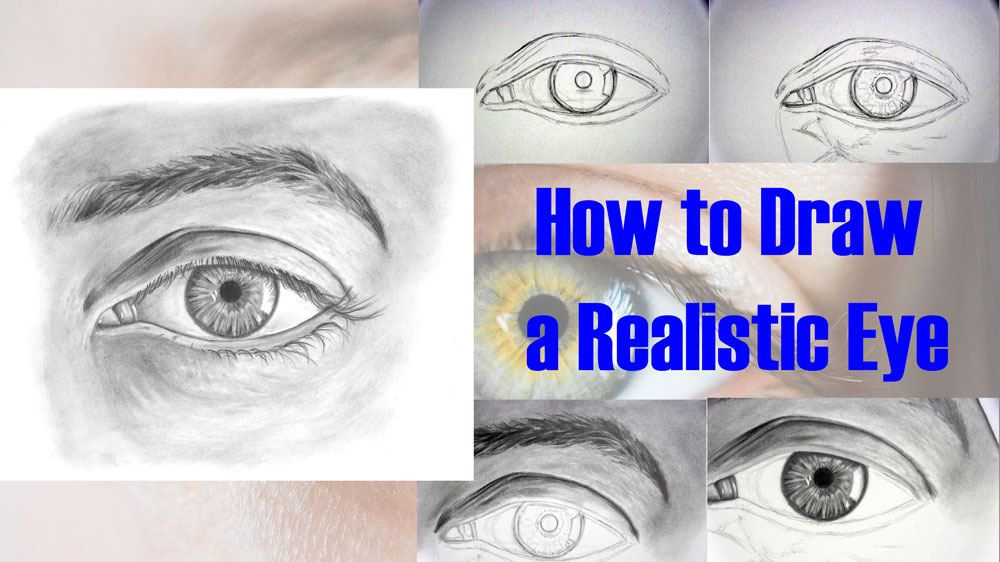
You may exist wondering, "How practice you depict a realistic eye with pencil?"
The eye definitely has a unique complexity to information technology that other facial features lack.
That'south not to say that drawing a nose, a rima oris, or an ear is all that easy for a offset artist.
Still you have to admit, the human being eye is intriguing enough to make it both a challenging and fun drawing discipline. In fact, the centre has e'er been my favorite facial characteristic to draw!
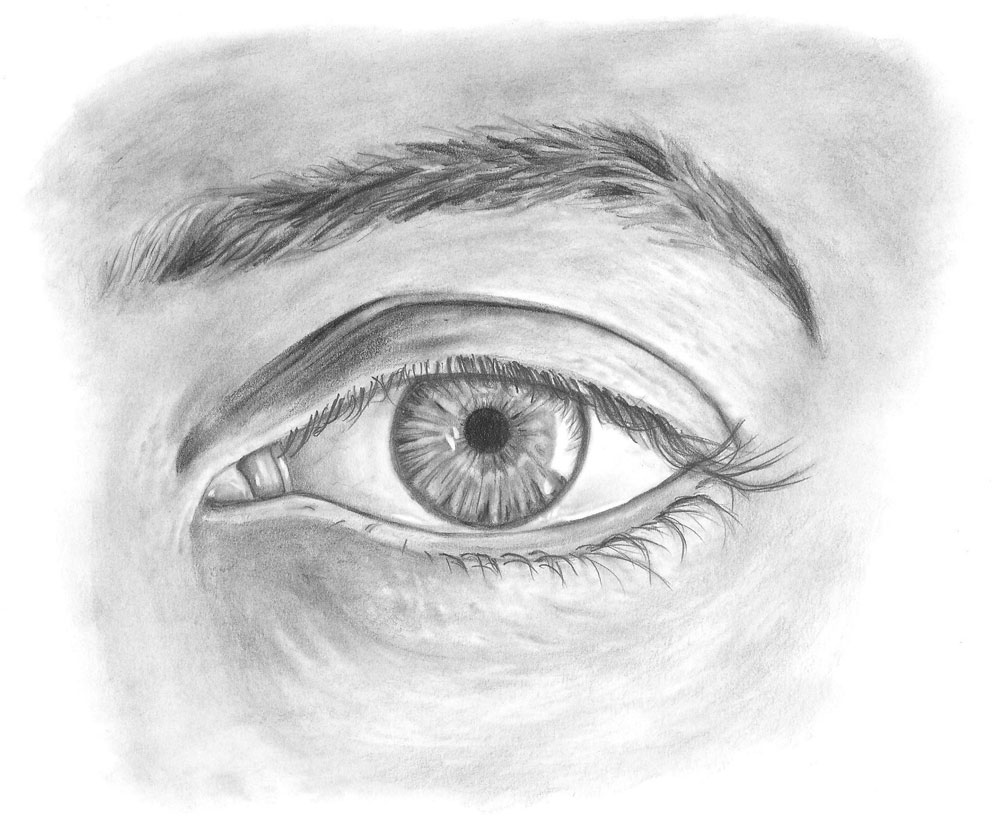
In this tutorial, I will show you how to draw an eye in a detailed and realistic style. You will acquire all near how to draw eyelids, an eyebrow, and eyelashes, in addition to how to depict the master parts of the visible eyeball like the iris and the pupil.
I will show you how to draw the initial outline and how to apply and blend shading in layers for a realistic wait. You will meet that it does not have to be difficult for beginners to describe a realistic eye.
Join me below so you can create your very own realistic eye drawing!
Use a Reference Photograph for a Realistic Eye Cartoon
Here is the reference photo for this tutorial. I chose to omit the pilus on the right side and its large vertical shadow and then I could make the eye the primary focus of the lesson.
Y'all can use the same concepts you larn from this tutorial and utilize them to drawing other realistic eyes.
Materials Used to Draw a Realistic Eye
Hither is a listing of the materials I am using for this drawing.
If you don't accept some of these materials, that's okay. You can still make practice with a regular pencil and eraser, as long equally you just get started!
If you wish to purchase any of these materials, they can exist establish at your local fine art store, or you can buy them using the links beneath.
Affiliate Disclaimer: The links below are affiliate links. I volition receive a small commission if a purchase is made through one of these links. Acquire more than here.
- 2H, HB, 2B, 4B, 6B, and 8B graphite pencils
- Mechanical pencil
- 0.5mm 2B lead refills
- Bristol board drawing paper
- Canvass of folded paper to foreclose smudging
- Blending stumps and tortillions
- Kneaded eraser
- Plastic eraser
- Dusting brush
- Electric eraser
- Circle template
How to Describe a Realistic Eye Video Tutorial
If you like, you lot can utilize 1 of the links directly below to access the complete video version of this tutorial. It will testify you my entire process for how to draw a realistic center pace past footstep with explanations from starting time to end.
Already a member of the Allow's Draw Today Club? Go to your courses.
Draw the Initial Eye Shape
We'll kickoff past drawing the initial outline of the eye with a 2H pencil. Begin by cartoon a slanted line near the left side of the newspaper for the corner of the middle. From here, extend another line that curves upward and back down to form the summit of the white function of the eye (and too the lower edge of the top eyelid). You may want to end along the style to make tentative placement marks for each side of the iris.
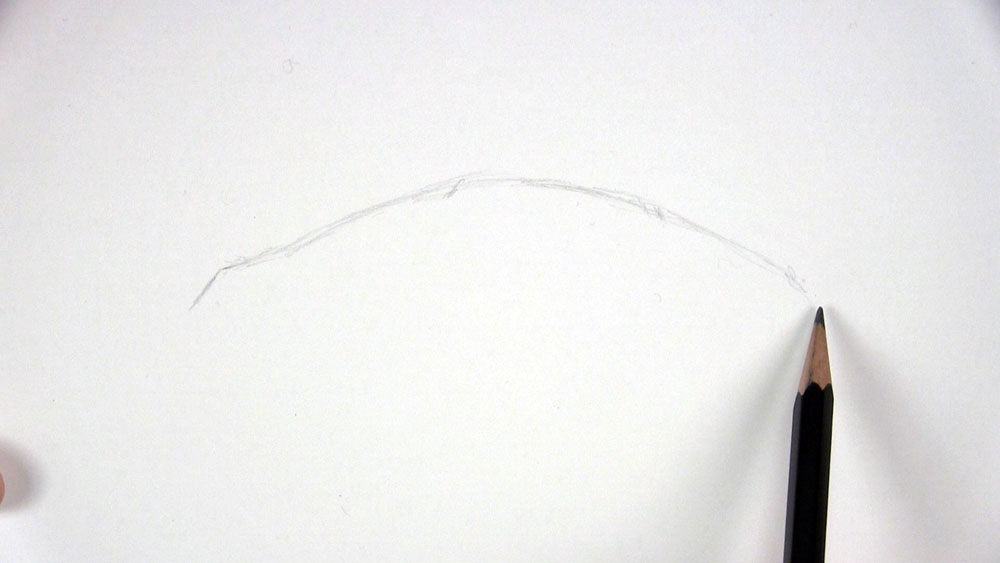
Use imaginary reference points and temporary guidelines to help you shape the outline of the heart so it will be a close match to the reference photo. For instance, the outer corner of the eye on our right side aligns roughly with the upper role of the inner corner on our left. Then, by sketching a horizontal guideline from the lower part of the inner corner, we know to grade the lower bend of the middle below this guideline but not too far below it.
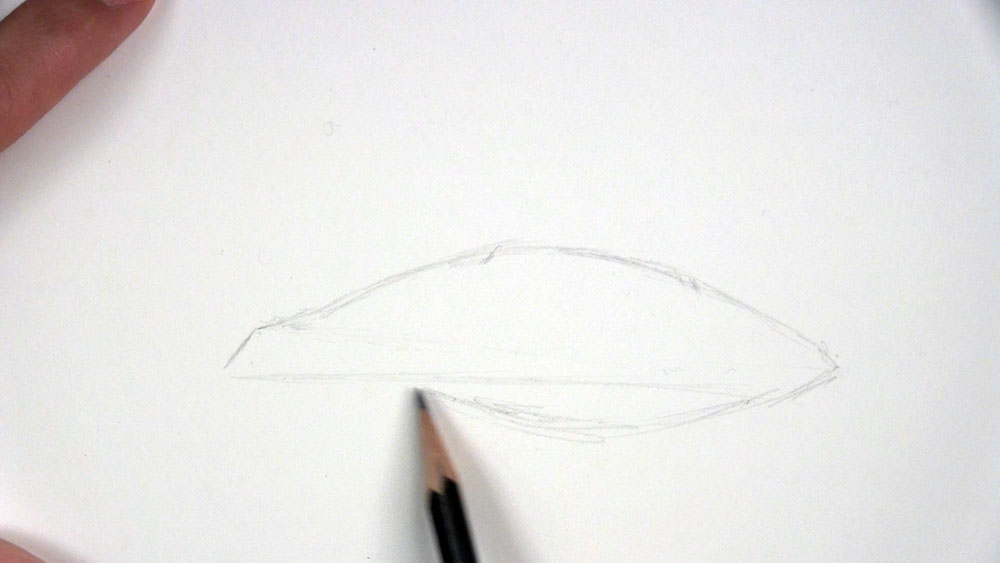
Stop drawing the corner of the heart past forming the base of the corner along the horizontal guideline. Draw two slightly curved, slightly diagonal lines at the corner from the tiptop to the bottom. These two lines represent the pink tissue found at the inner corner. You should stop up with somewhat of an almond-shape for your eye.
Draw the Eyelids
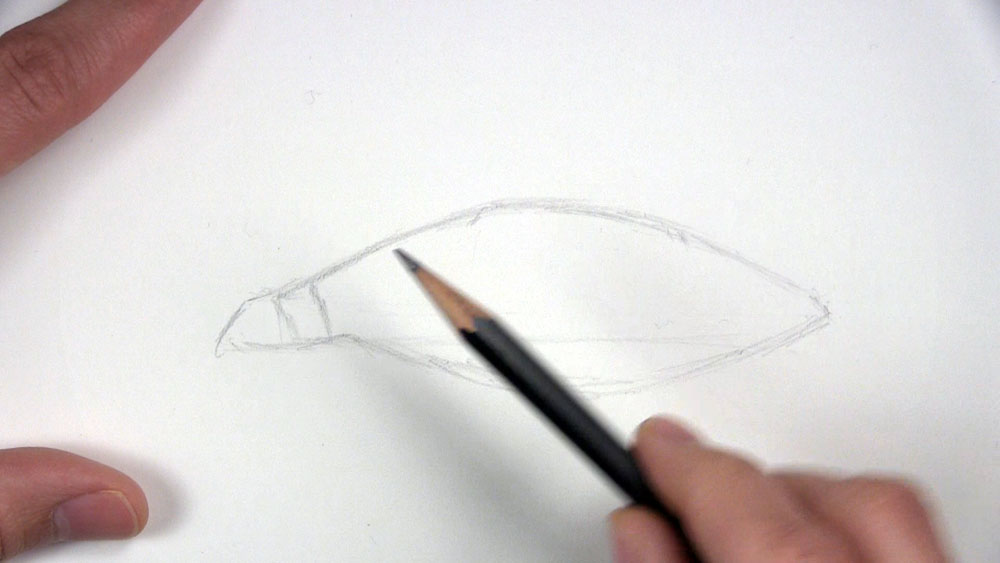
Sketch a line for the acme of the top eyelid. This line should follow the same general curvature as the line already drawn for the lower role of the meridian eyelid. Directly underneath this line and very close to it, sketch two more lines running alongside it. These lines represent wrinkles in the upper portion of the eyelid. Sketch some other shorter wrinkle. Finally, draw a line along the lower edge of the eyelid. This is where the eyelashes will get toward the end of our drawing.
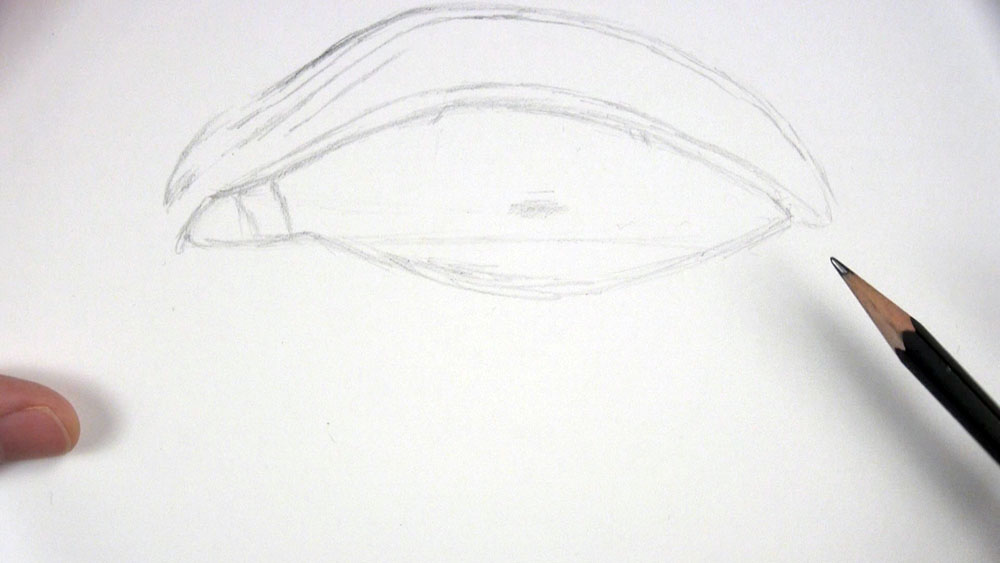
Sketch a line below the almond shape already fatigued, once more post-obit the same curvature. This line will represent the upper edge of the lower eyelid. The lower eyelashes will be placed here later on.
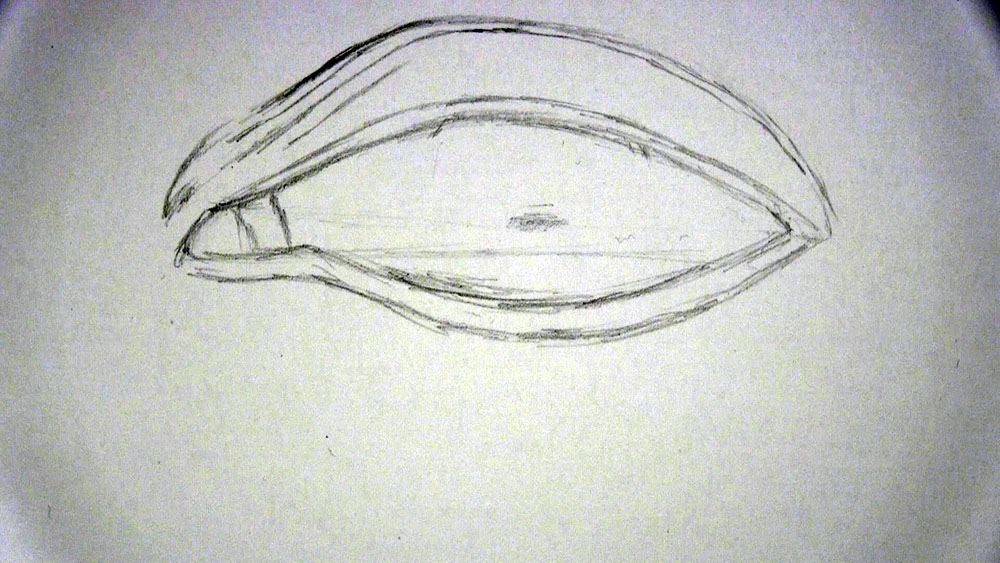
Draw the Iris Outline
Sketch a vertical guideline to found the guess center divider of the iris. Remember those tentative lines we marked along the top border at the beginning? This vertical guideline should exist centered betwixt the two.
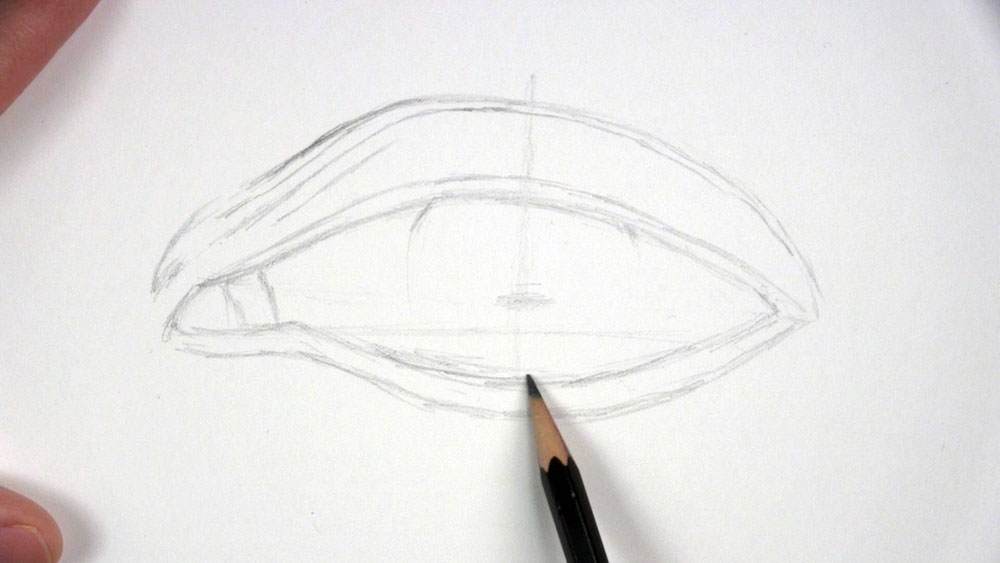
Sketch a circle for the iris. Use the guidelines to assistance you shape it every bit round as possible. You may find information technology helpful to sketch the upper portion of the iris that is hidden backside the upper eyelid. If you accept difficulty drawing a circle, you lot can trace a round object of a comparable size that you might take on paw, or you can employ a compass.
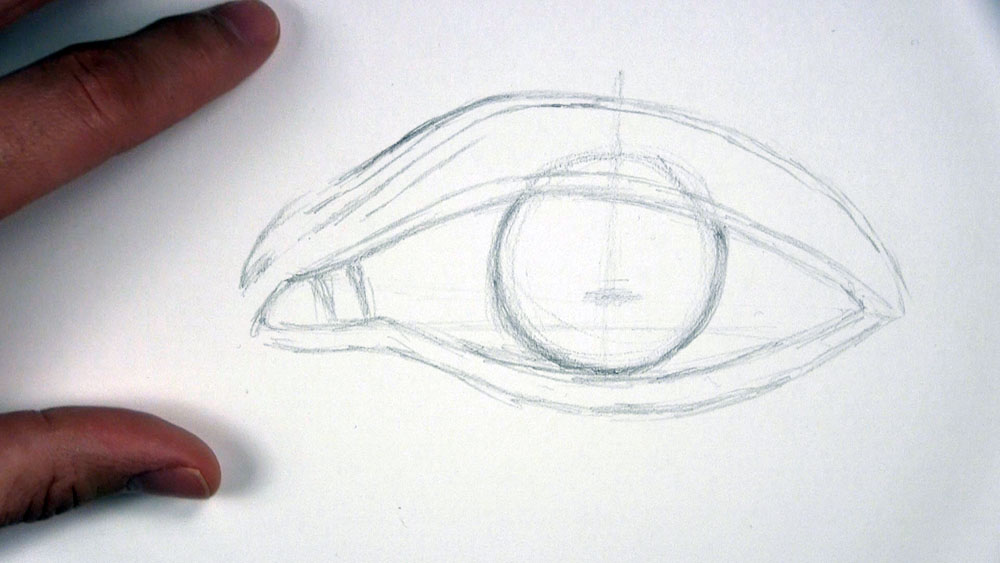
Outline the Pupil
To draw the pupil, sketch a much smaller circle in the center of the iris. Only sketch the general shape as round as you can, simply like the iris.
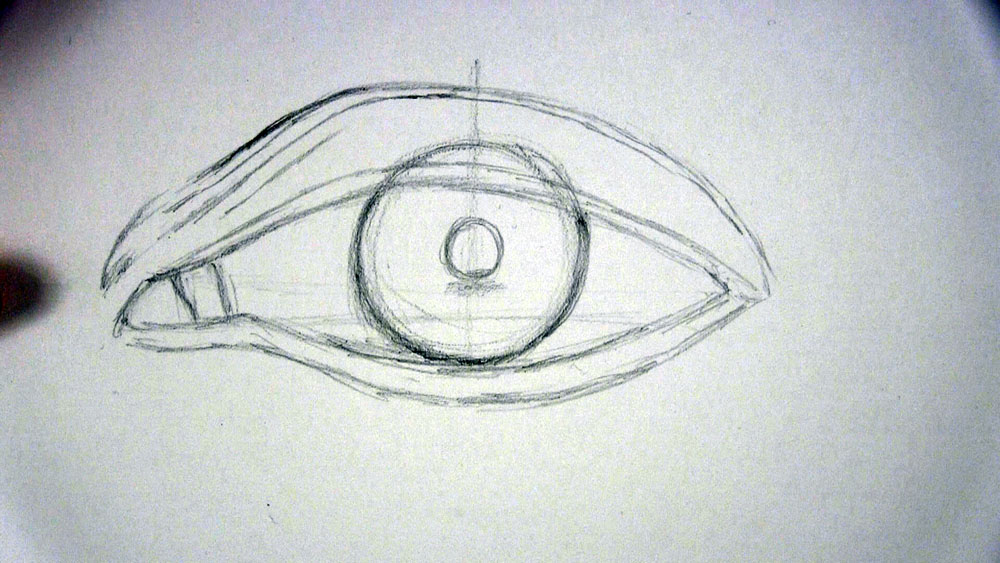
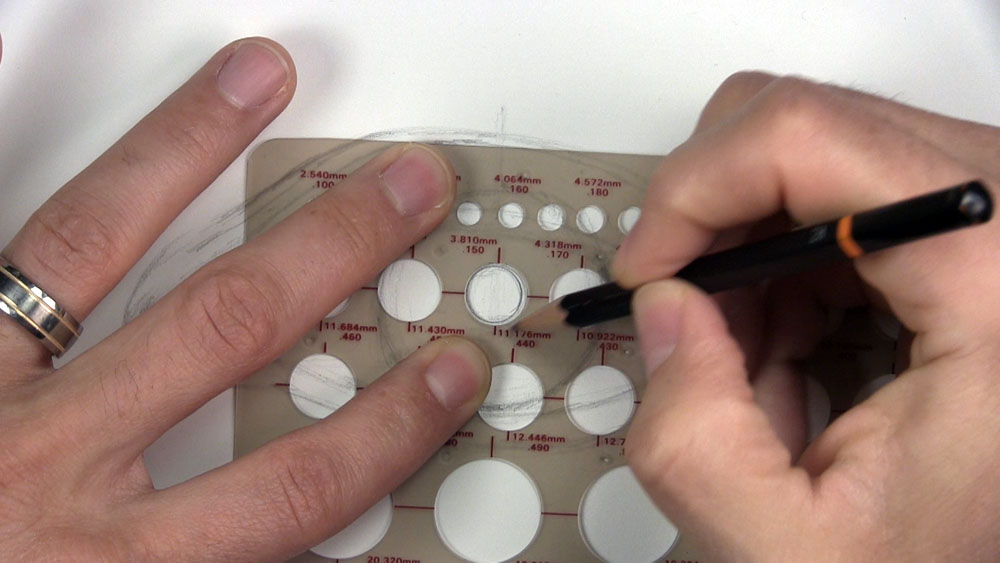
Check that the distance from the border of the educatee to the border of the iris is the same all the way effectually. Y'all can practice this by marking the distance forth the edge of a scratch piece of newspaper and checking that altitude with the other distances around the student. Once yous are sure the student is centered, y'all tin use a circle template to make the pupil perfectly round.
Depict Details on the Iris
Make any adjustments as necessary. I decided I wanted to raise the upper eyelid a little chip so more of the upper iris would be visible in my cartoon. Yous tin can also erase any guidelines, such equally the upper hidden portion of the iris.
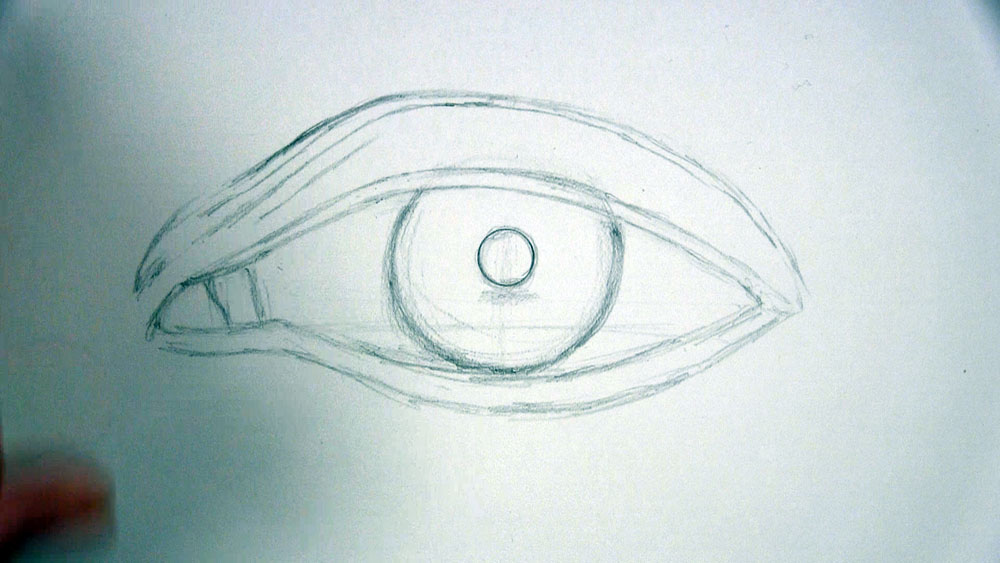
At present let's add some lines to indicate highlights and shadows. On the right side of the iris, describe a large highlight. This highlight is near rectangular in nature, only of course the edges should curve along with the curvature of the iris. And then depict a line curving closely forth the inner border of the iris. This will exist the limbal band of the iris. Draw a line on the upper role of the iris but under the elevation eyelid for a cast shadow. Finally, sketch a few lines for lite shadows on the white of the eye, namely under the eyelid and curving virtually the inner corner.
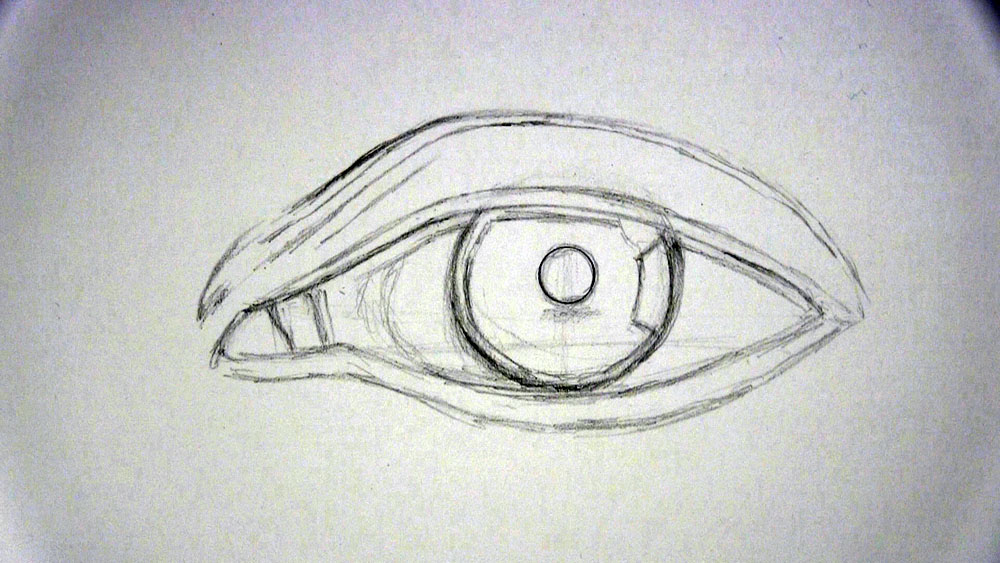
If you lot look closely at the reference photo, you'll notice a bright squiggly ring on the iris that surrounds the student. Draw a squiggly line around the educatee. And then draw skinny bands on the outside of this squiggly line that radiate toward the outer edge of the iris. These bands should taper near the outer edges and look something similar sunday rays. Brand certain to draw these piffling details, because they are an important step in creating a realistic eye.
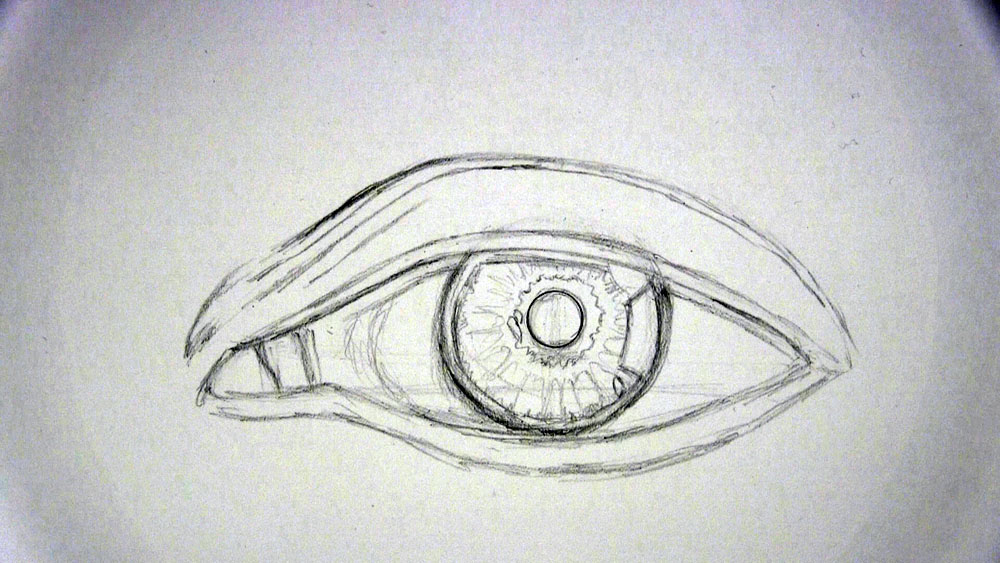
Draw Details on the Eyelids
On the upper eyelid, draw a couple of very low-cal irregular lines. Draw i simply over the left border of the iris and the other but to the right of the iris. These lines will represent shadows and highlights on the upper eyelid.
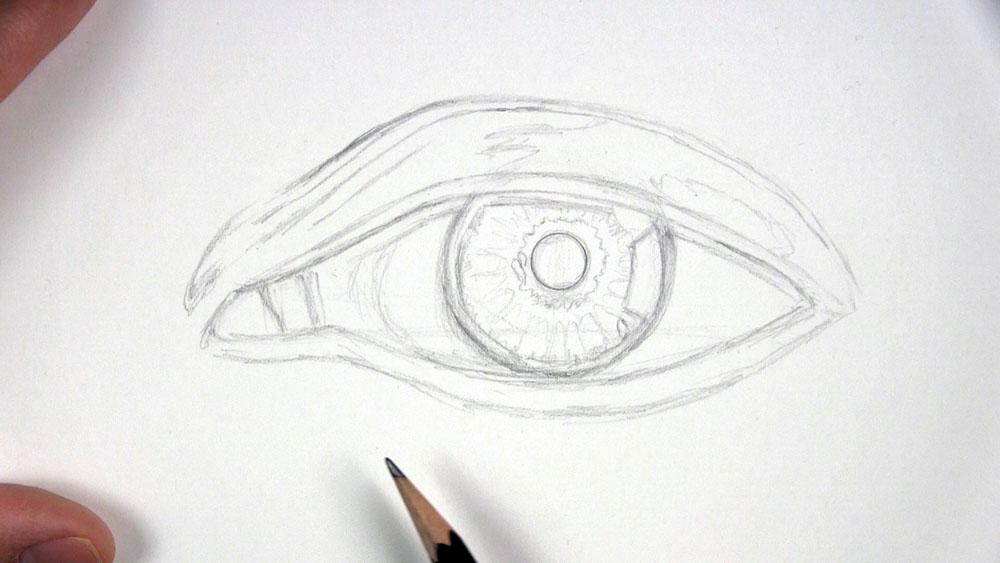
To draw the lower eyelid, it'southward important to remember that the lower eyelid rests on the lower portion of the eyeball, and the eyeball is a sphere. From the inner corner of the eye, sketch a very light and loose guideline to form the outer border of the eyeball that is hidden behind the face.
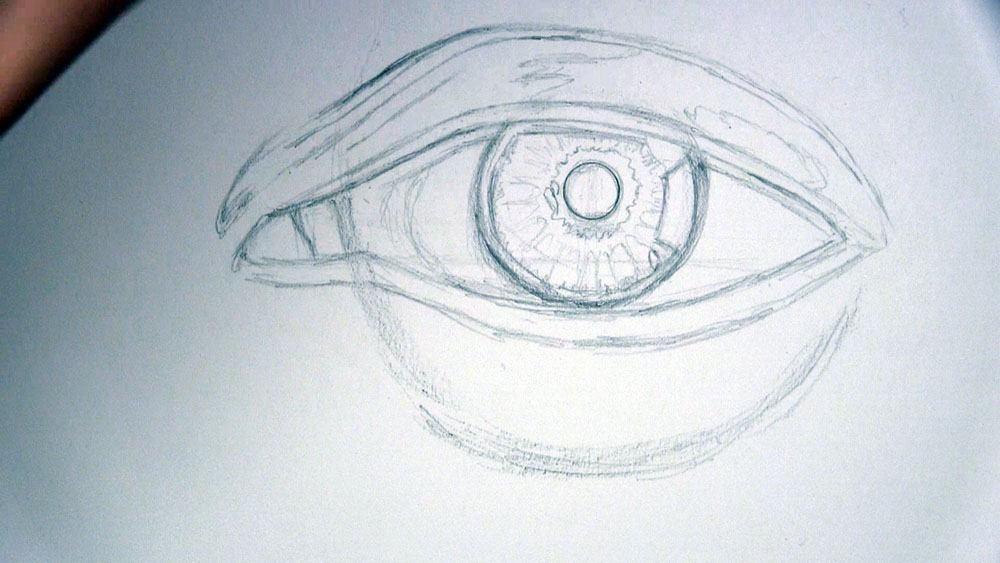
Like to what we did for the top eyelid, sketch a light irregular line to place a shadow on the left side of the lower eyelid.
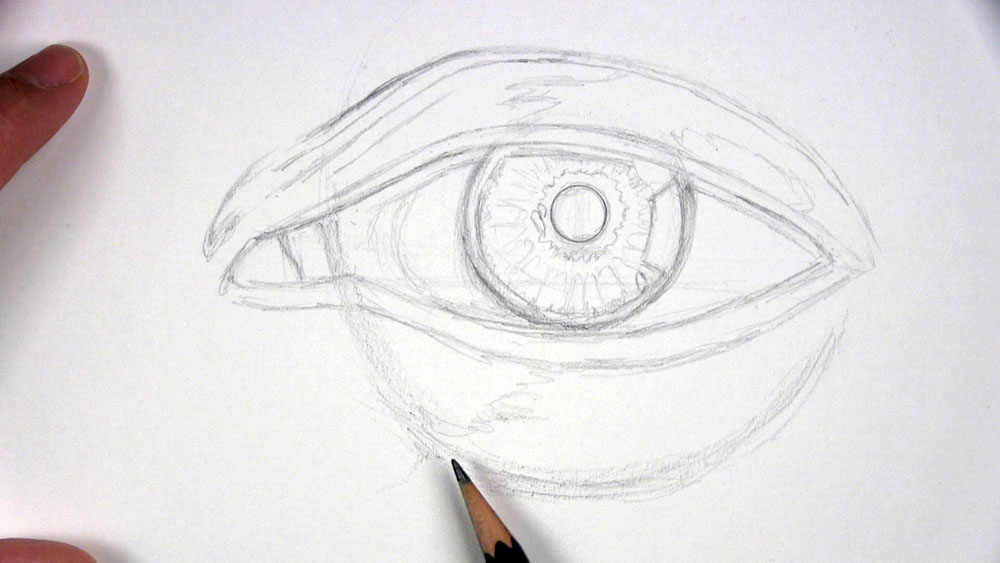
Sketch a few additional lines to the left of the eyeball. These markings will indicate shadows and other value variations in this surface area of the eye. Besides, sketch a line drooping down from the inner corner and curving with the eyeball to give a rough approximation of where the nose can be found.
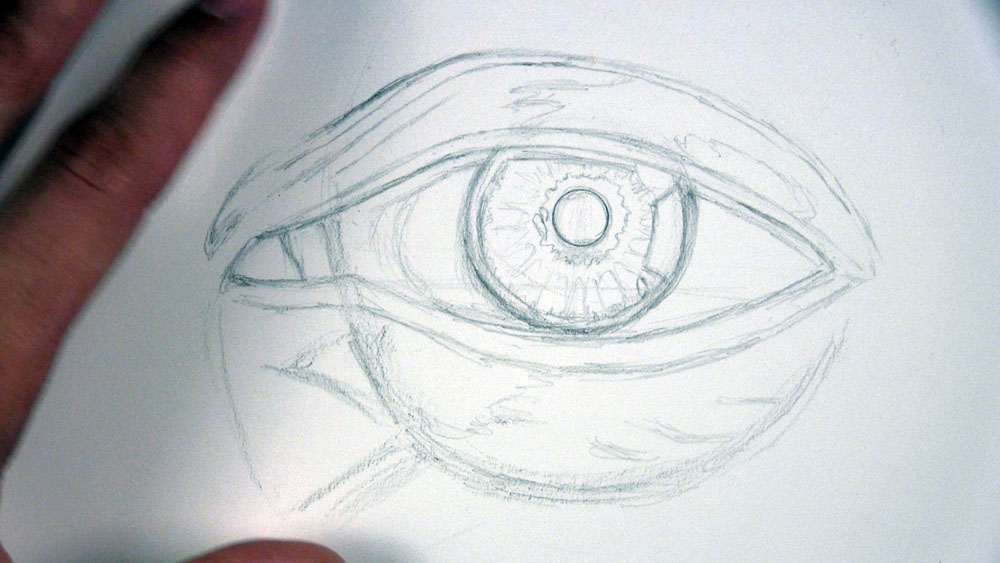
On the right side of the lower eyeball, sketch a few horizontal lines for wrinkles on the lower eyelid. Then nosotros can erase the spherical guideline for our eyeball.
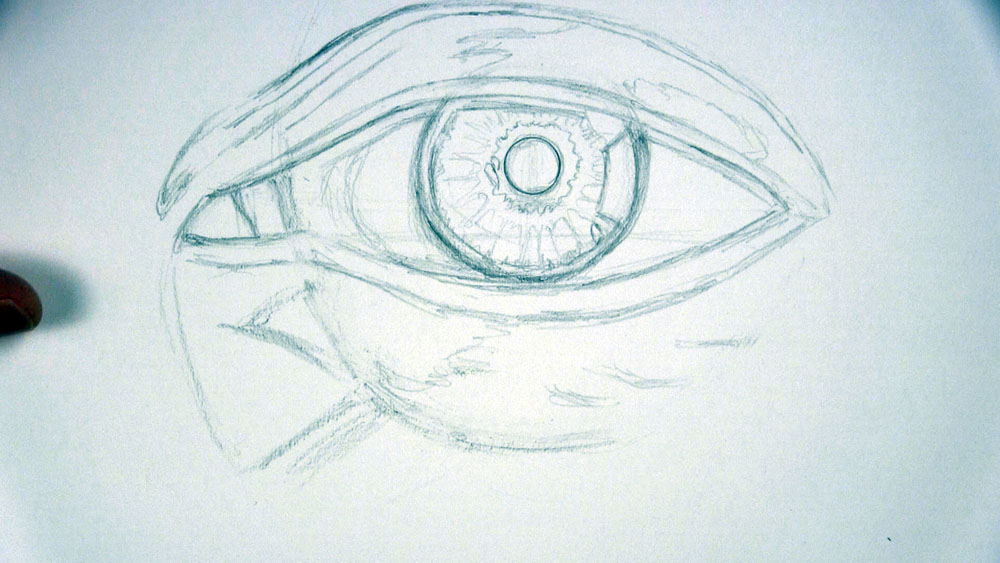
On the pink tissue at the centre'southward inner corner, draw 1 or two squiggly lines to stand for moisture and shadows.
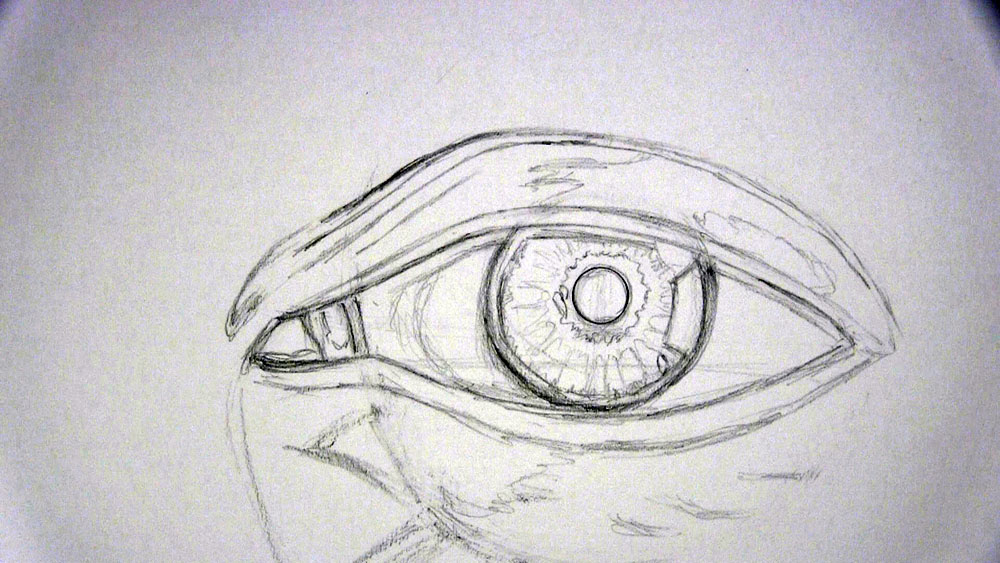
Draw the Countenance Outline
Side by side, allow'southward draw the lower edge of the eyebrow. I'm choosing to brainstorm at the inner corner where the eyebrow is thicker. Draw your line going upwards from the corner and start to bring it back down when yous are slightly to the right of the student. Plan on tapering the eyebrow at this outer corner. In the example y'all see hither, the distance between the eyebrow and the upper edge of the heart is acceptable for a general center drawing. Nonetheless, I decided to make mine lower later in the drawing and then it would more than closely match the reference photo.
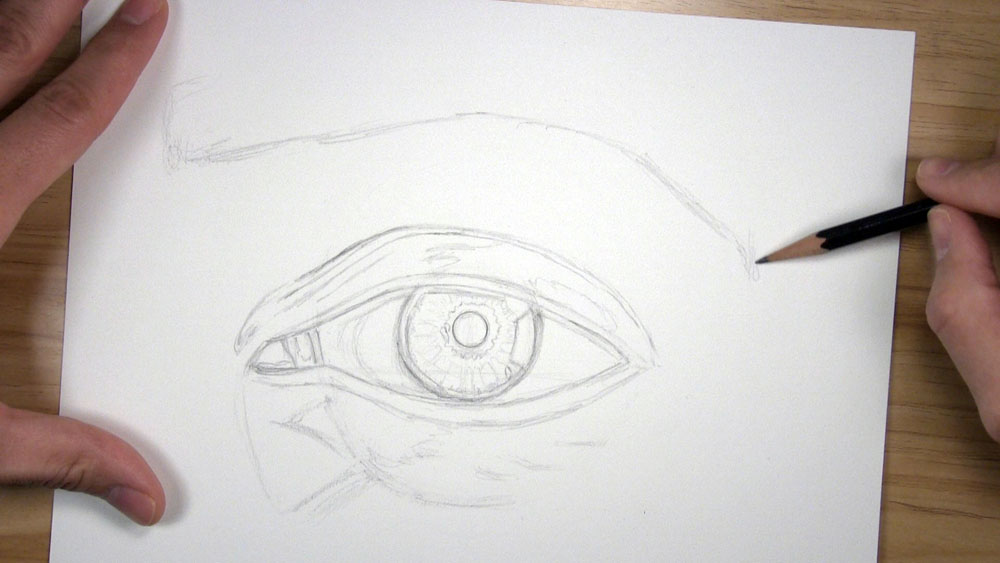
Cease the outline of the eyebrow by drawing the line to form the upper role. Be careful non to brand the eyebrow too thick or too sparse. Continue to make comparisons of width between other potions of your drawing and with the reference photo, too.
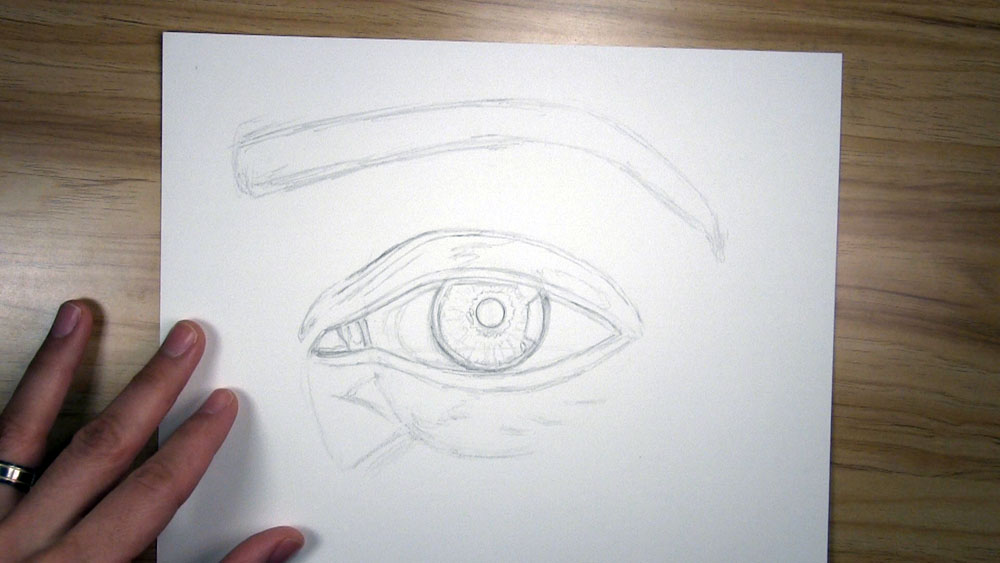
If you would like an easier and more accurate fashion to brand the line drawing of the realistic middle than the freehand method I'yard using, you tin can try the transfer method, grid method, or a plot-signal method for boosted support. I have ready-made outlines, grids, and plot-point downloads for this tutorial and others available for members of the Allow's Draw Today Society.

Pencils Used to Draw a Realistic Eye with Shading
As we movement on to the shading portion of the drawing, here's a quick note about the pencils. I advise using an HB pencil for the lighter areas, a 2B for midtones, and a 4B for the shadow areas.
I switch pencils quite often during this entire process, so I won't mention each fourth dimension I switch in the steps below. If you really need to know every time I switch pencils during every stride, I practise walk you through that in the extended video version of this tutorial.
Shade the Surface area Above the Eye
Shade the eyebrow. Normally, I similar to shade the skin underneath the countenance before drawing the eyebrow's hairs. This first layer of shading can represent the shadows on the peel beneath the individual hairs. I want the space for the countenance to be a little flake darker than the surrounding skin. Therefore, one time the peel is shaded, the darker area volition help to maintain the placement of the eyebrow.
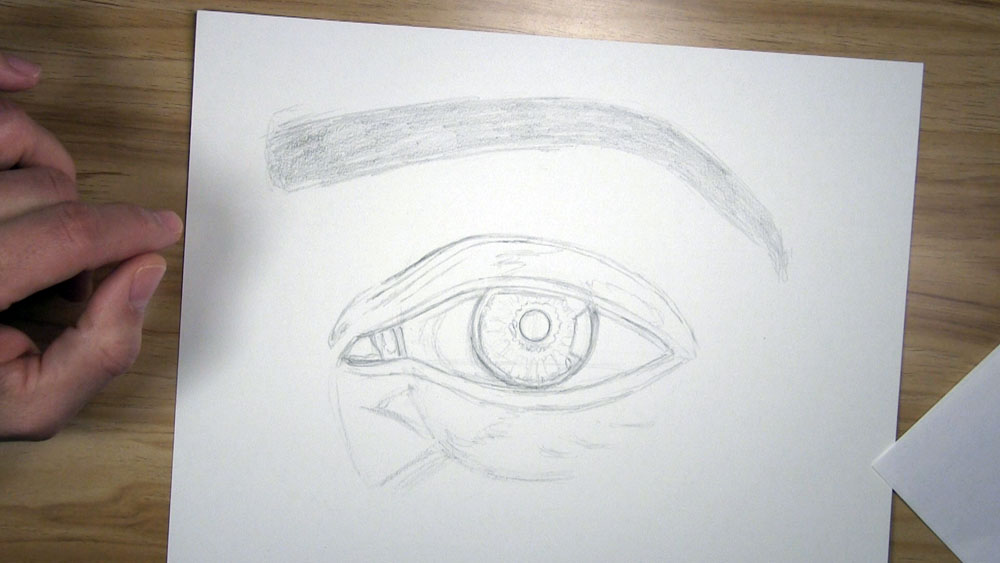
Adjacent, lightly shade the skin tones surrounding the eyebrow. Begin with the expanse to a higher place the countenance. Shade in a management like to the management of the countenance. When shading the skin, many artists use a hatching approach, keeping the tones very close together and going in the same direction. Many other artists employ the more time-intensive circulism, with tight circles very shut together, to reach more realistic textures on the skin. Here, I'thou going with a hybrid approach, using elongated circular strokes that are besides diagonal.
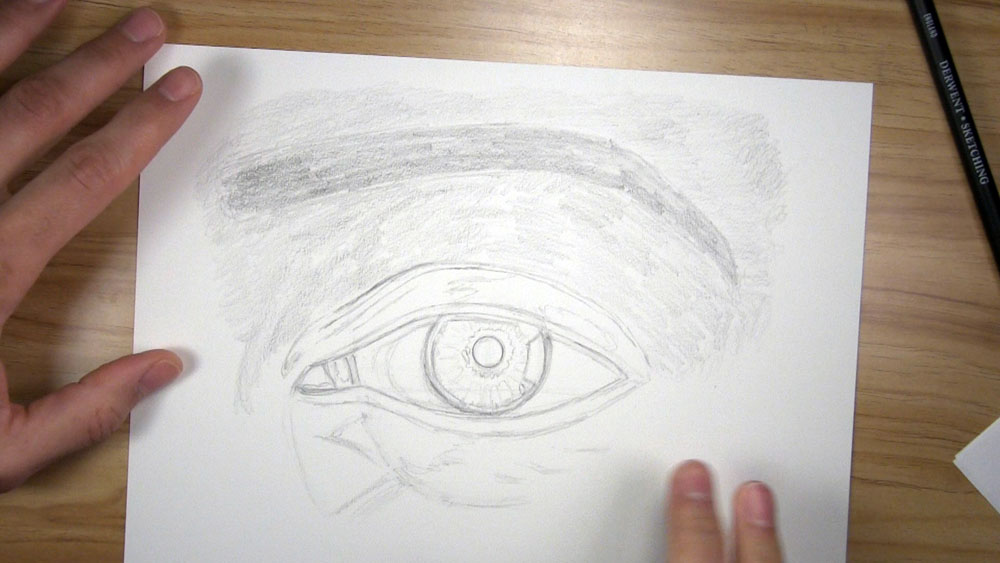
Apply a blending stump to blend all of the graphite tones of the skin. Alloy in a manner similar to how the pencil strokes were applied. Effort to smooth over any grainy patches of graphite.
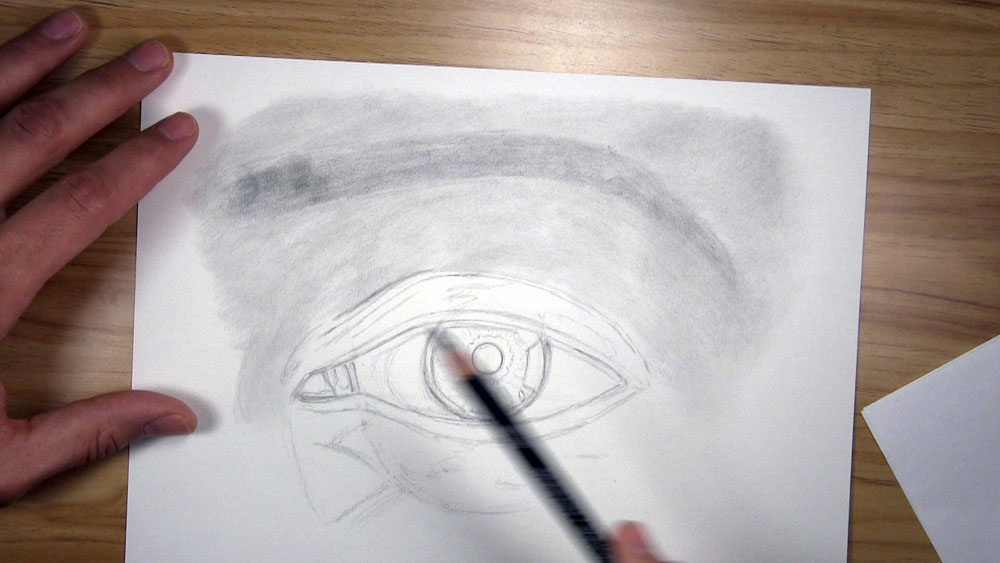
Develop Layers of Shading on the Eyelid
Utilise some other layer of graphite on the skin over the eye. Put slightly more shading on the left side than the right, where the lite source is leaving a lighter expanse. And so alloy these tones one time again with a blending stump.
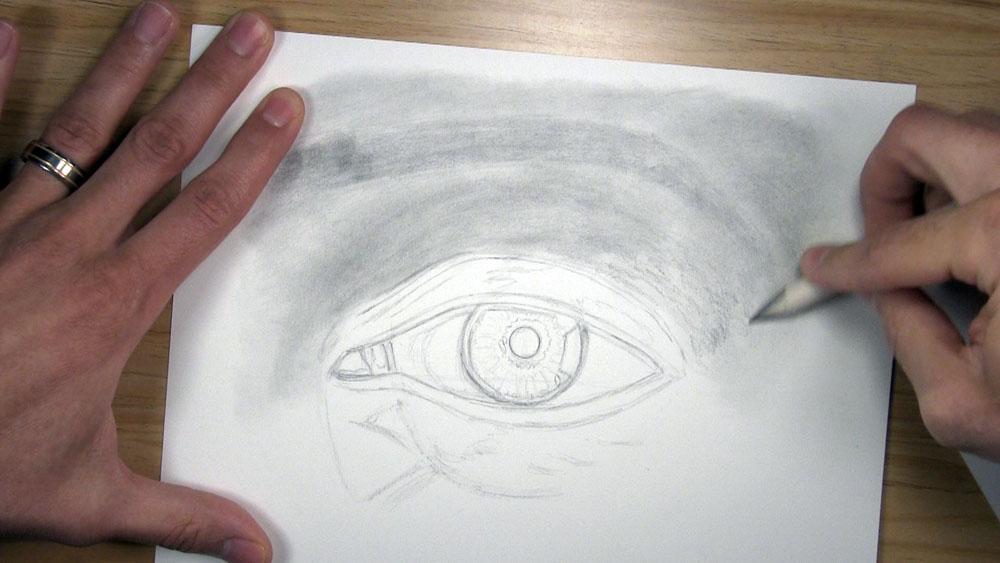
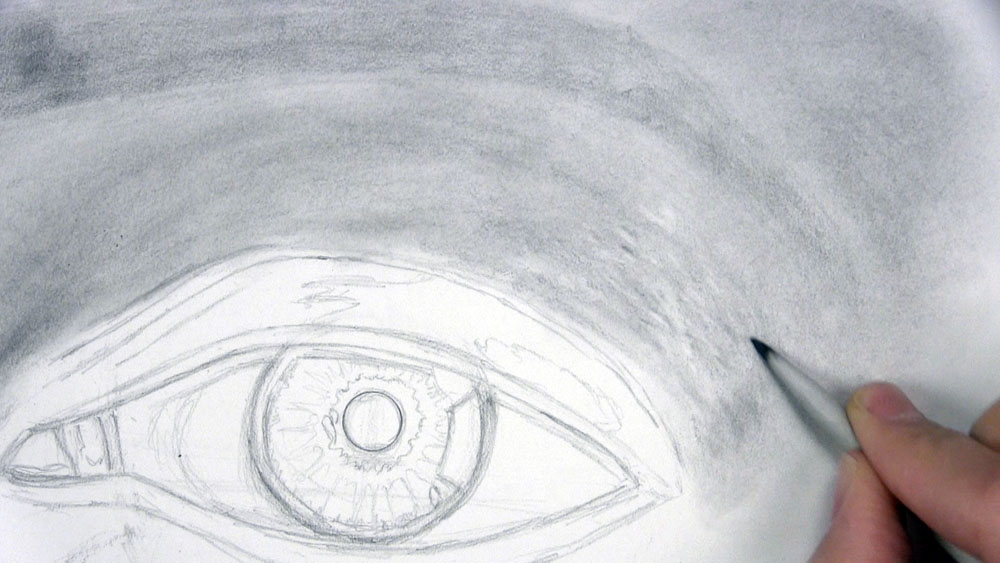
With the long, apartment edge of a kneaded eraser, scoop out a few thin highlights on the surface of the skin between the outer corner of the eye and the eyebrow. Doing this will assist to create some texture on the skin that tin be seen more hands in the highlighted area. Utilise graphite residue on the tip of a tortillion to create some thin shadow marks directly adjacent to some of the highlights. This will enhance the skin texture.
I Desire to Move My Eyebrow
Here'due south where I decided to move the eyebrow downwards a trivial lower. I maintained the same shape and size every bit before, merely I moved the position directly below the previous i. Again, if yous are happy with the placement of the eyebrow in your drawing, you can skip this footstep and the next one.
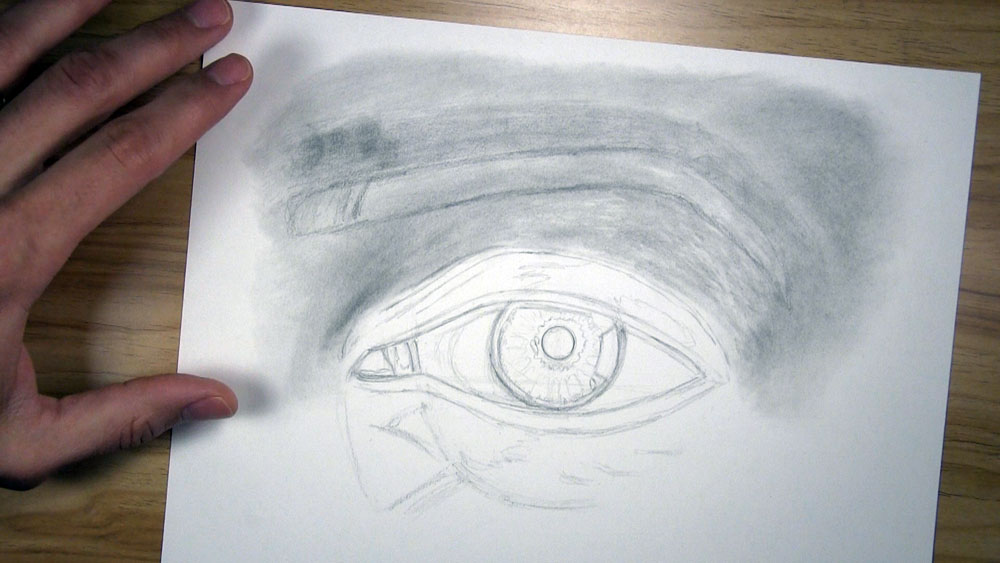
Then I used a kneaded eraser to absorb the dark area where the eyebrow was originally going to be. The purpose of this blotting was to lighten the tones so they take the same value as the surrounding pare.
Begin Shading the Eyebrow
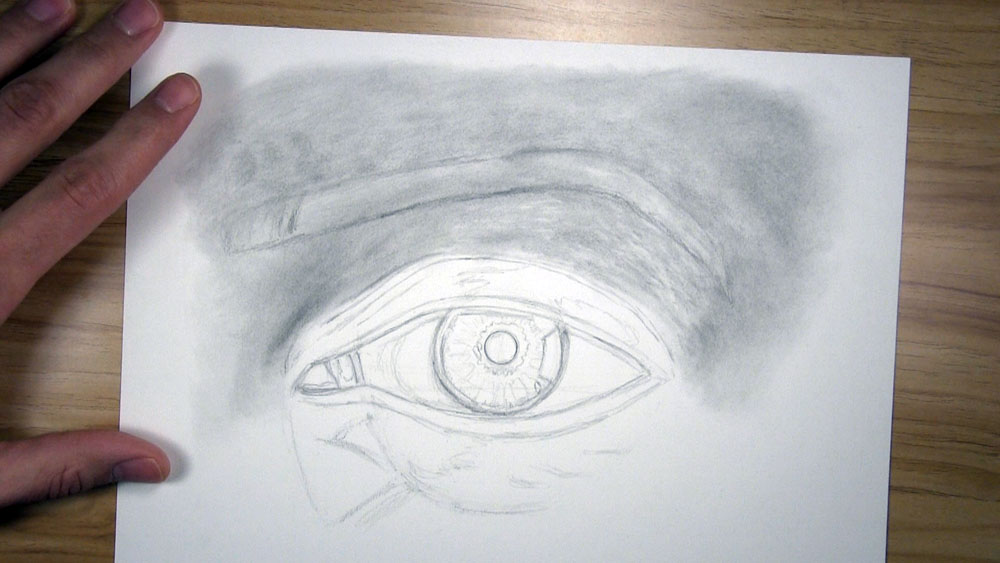
Begin drawing the hairs of the eyebrow. Starting on the left, brand light pencil strokes from the base of the eyebrow going upwardly. Make these lines twist and curl in the same general direction equally the hair growth.
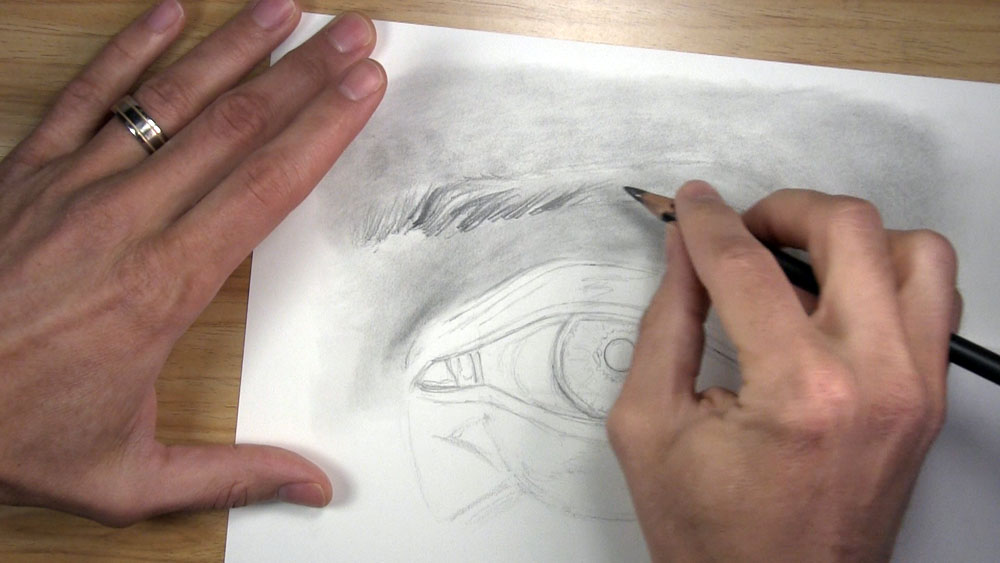
Go along cartoon the hairs of the countenance. Look at the reference photo to help you make up one's mind how the hairs are growing and which clusters of pilus are thicker than others and require heavier graphite. Draw hairs jetting in and to the right from the superlative and bottom edges. Leave some gaps between some of the hairs. Notice how the eyebrow gets a fiddling thicker at the end and then tapers to a point nearly the right end.
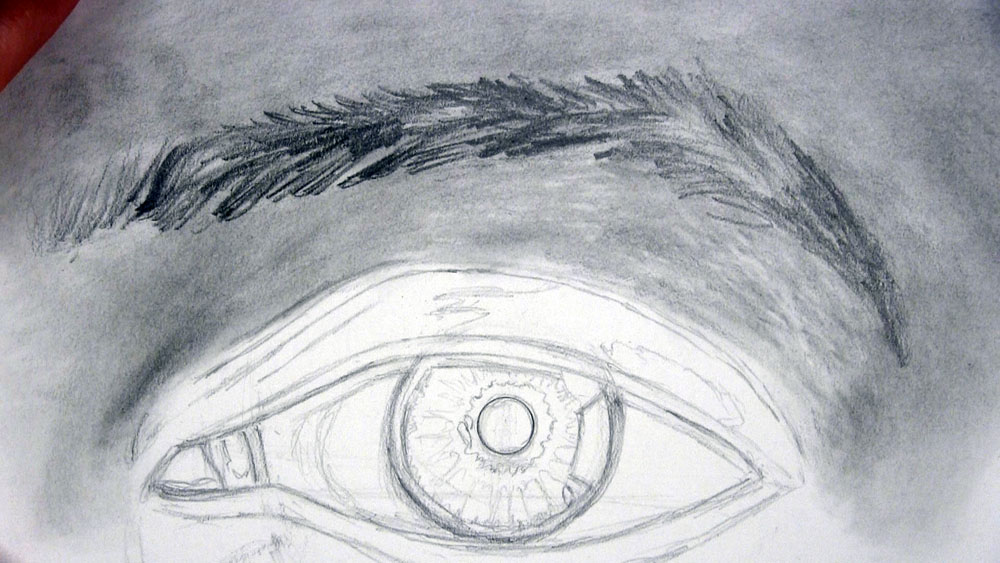
Blend the tones of the countenance with a blending stump. Again, follow the management of pilus growth.
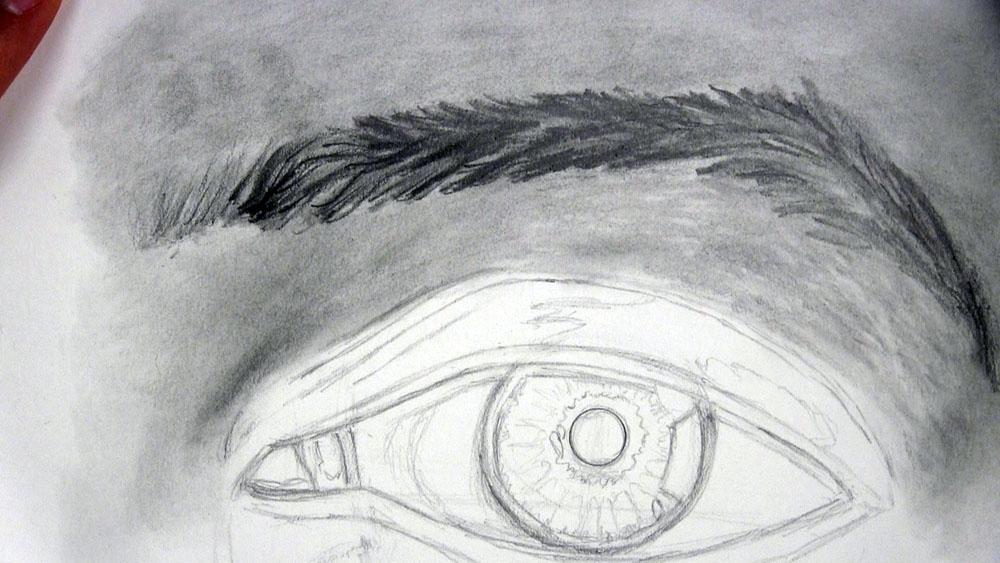
Build the Eyebrow Upwardly in Layers
Draw some other layer of hairs over the countenance. These additional layers add volume to the eyebrow. So alloy the markings.
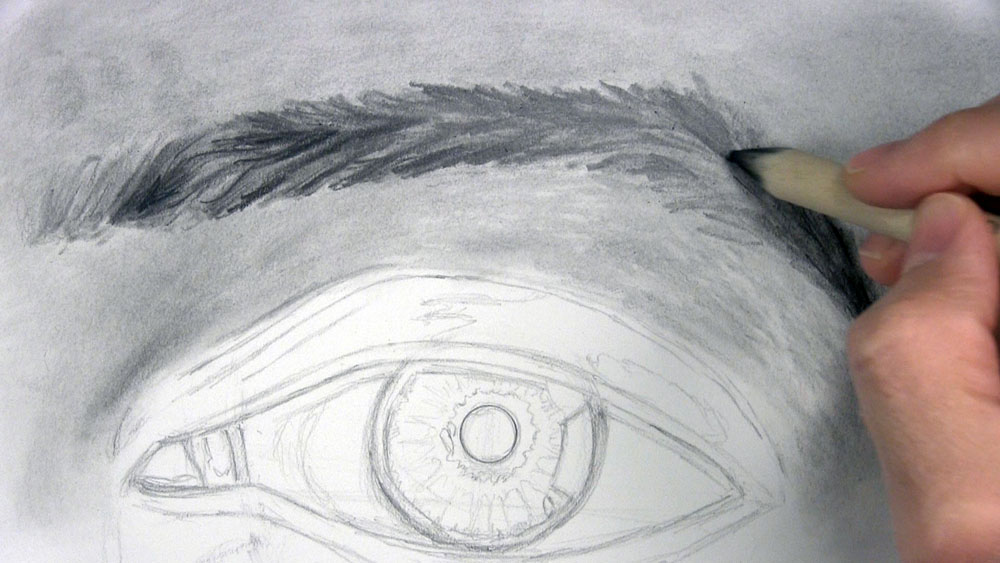
Utilise a kneaded eraser to elevator streaks of highlights from the eyebrow. If you have always wondered how to draw realistic eyebrows, these highlights mixed amidst the darker values go a long way towards creating that realism.
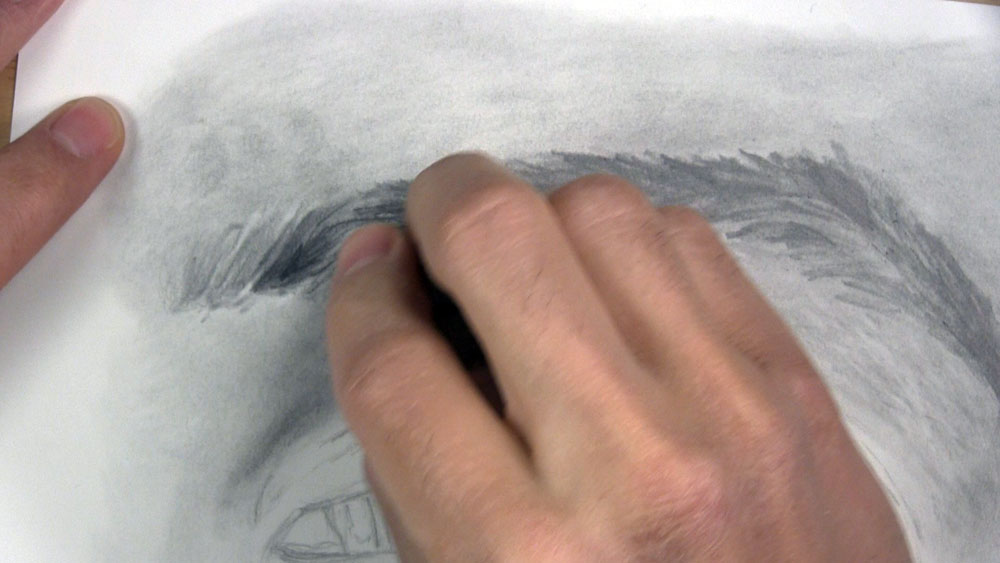
Utilise a mechanical pencil to draw fine hairs that are apparent within the highlighted areas of the countenance.
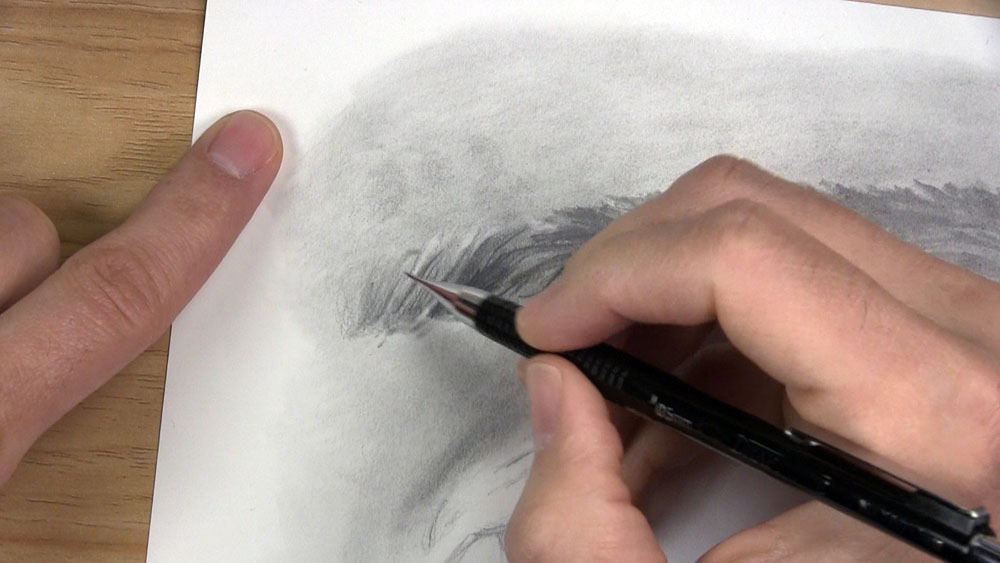
Apply a tortillion to blend over the fine hairs. Proceed working to add pocket-size details to the eyebrow.
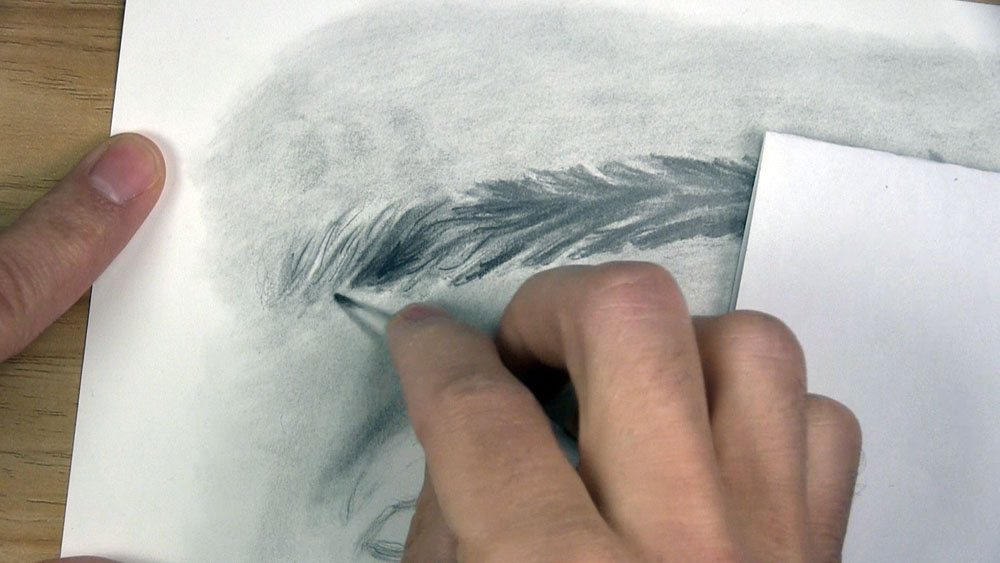
Work your way across the unabridged surface of the eyebrow. Alternate between the pencil, kneaded eraser, and tortillion to build multiple layers of pilus over the eyebrow. You can reach this look of drawn pilus by drawing darker streaks next to lighter streaks. Occasionally, draw hairs that come from the darker areas and extend into the highlighted patches. Brand several stray strands of hair on the outer edges also as strands overlapping lighter areas. Go along layering additional details over the eyebrow until it is consummate.
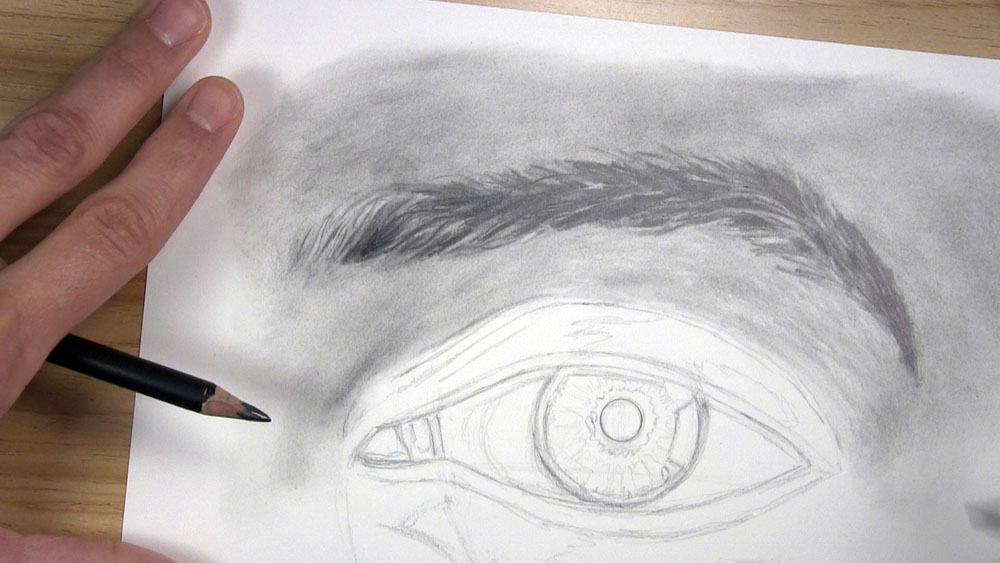
Shade the Upper Eyelid
Put shading forth the upper edge of the top eyelid. While doing and then, also outline the contraction lines and then they stand up out confronting the darker tones.
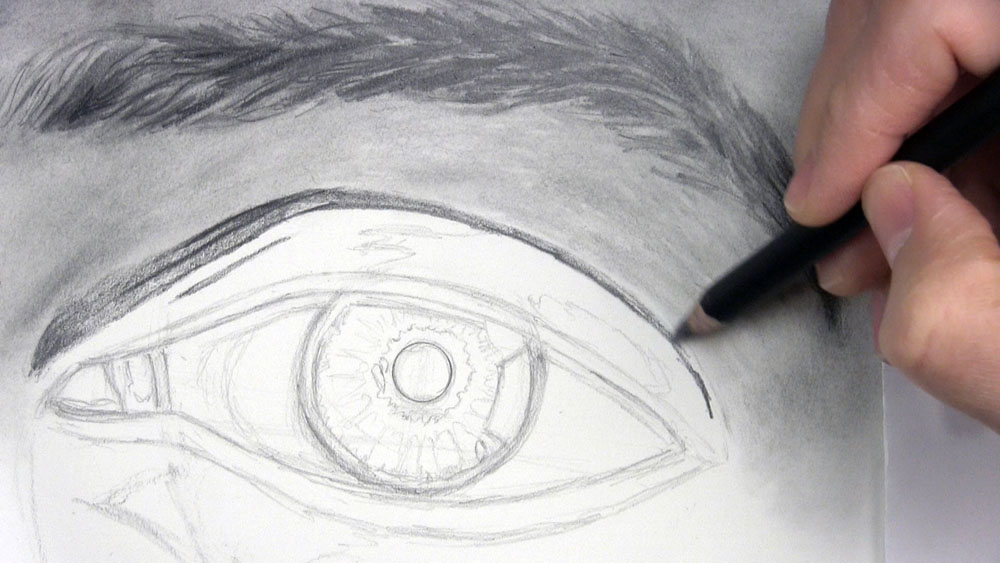
Bring this shading further downward the eyelid. Use the guidelines from the line cartoon to help yous make decisions about which areas need more than shadow. In this drawing, the light source is coming from our right side, so at that place should be more shadow on our left.
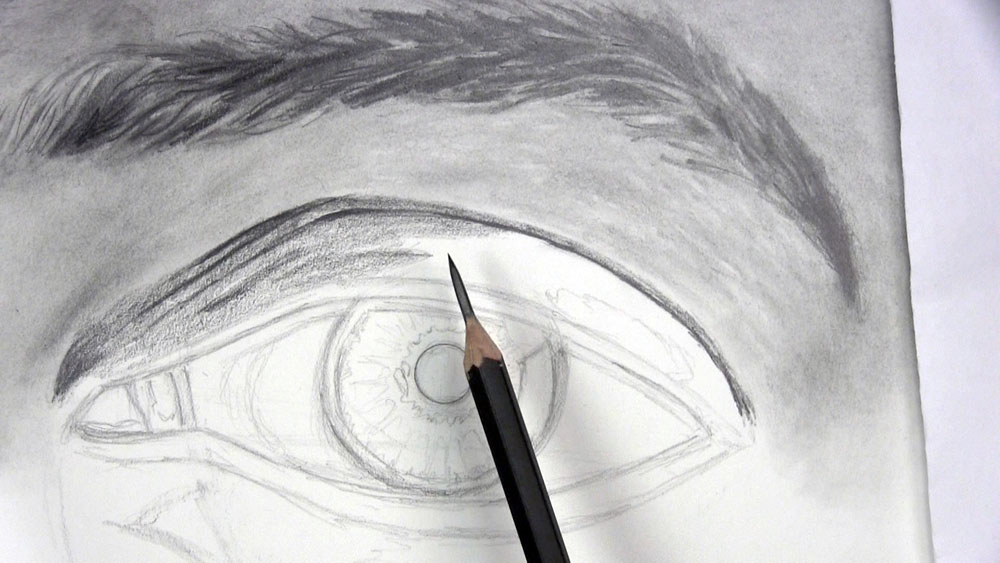
Put lighter applications of tones on the right side of the eyelid. And so blend the tones. Every bit you blend, try to preserve some of the highlighted areas.
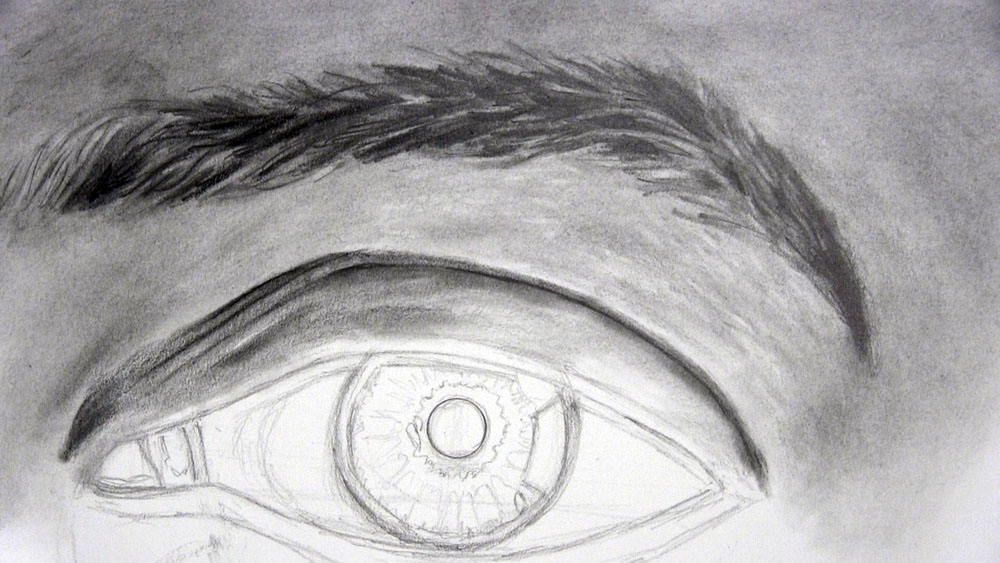
Put another layer of darker shadow tones on the left side of the eyelid. Place the darkest tones at the corner and just to the upper right of it, while at the aforementioned time using the contrast of darks and lights to amend define the eye socket. Use a kneaded eraser and tortillion to create texture in the pare on the right side of the eyelid. Oh, and don't forget to shade the lower edge of the eyelid too!
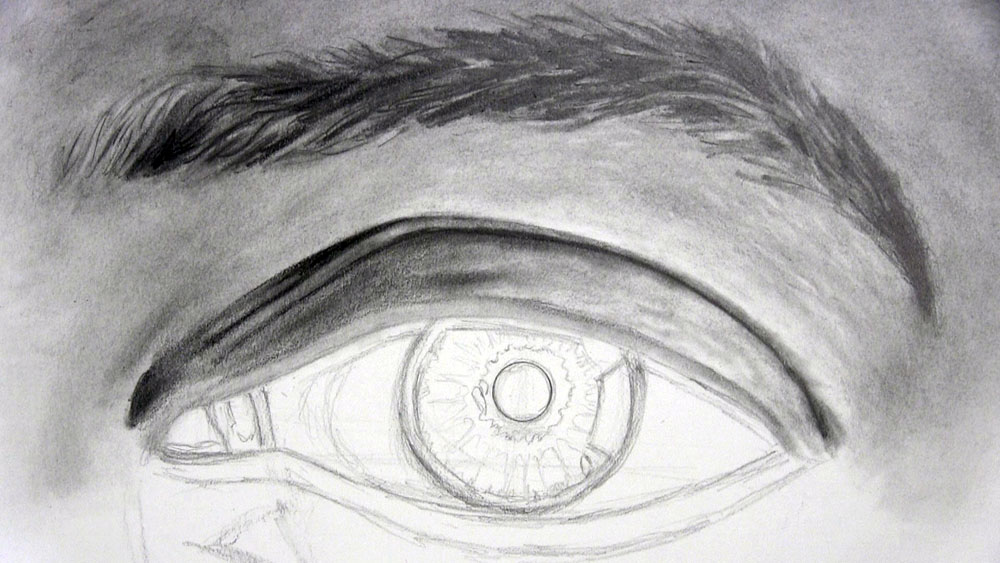
Identify an extra layer of blended shading at the corner of the heart. Use a kneaded eraser to lift highlights at the corner.
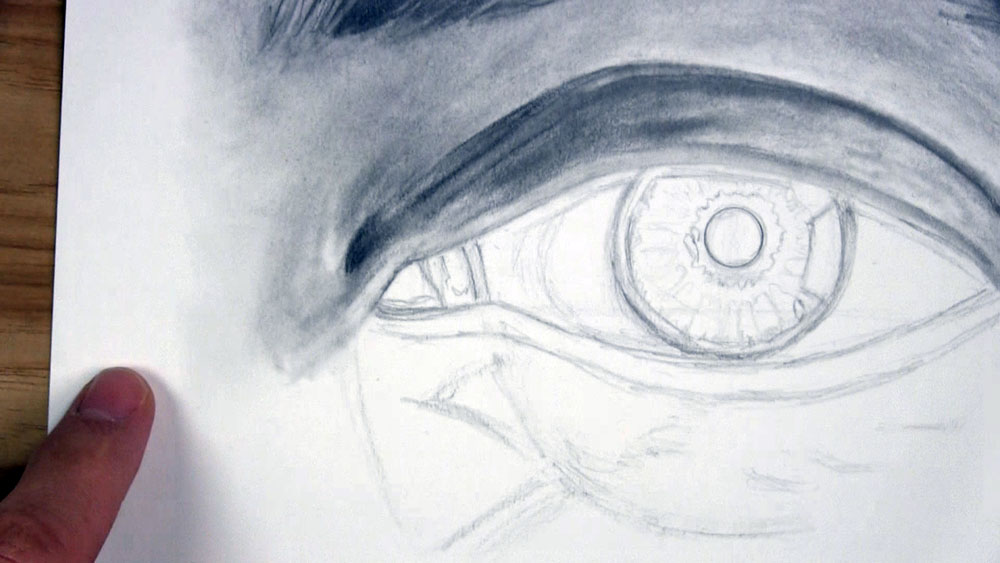
Shade the Inner Corner of the Eye
Brainstorm shading the lacrimal caruncle, which is the first piffling pink tissue at the corner of the center. Put more than shading virtually the lesser.
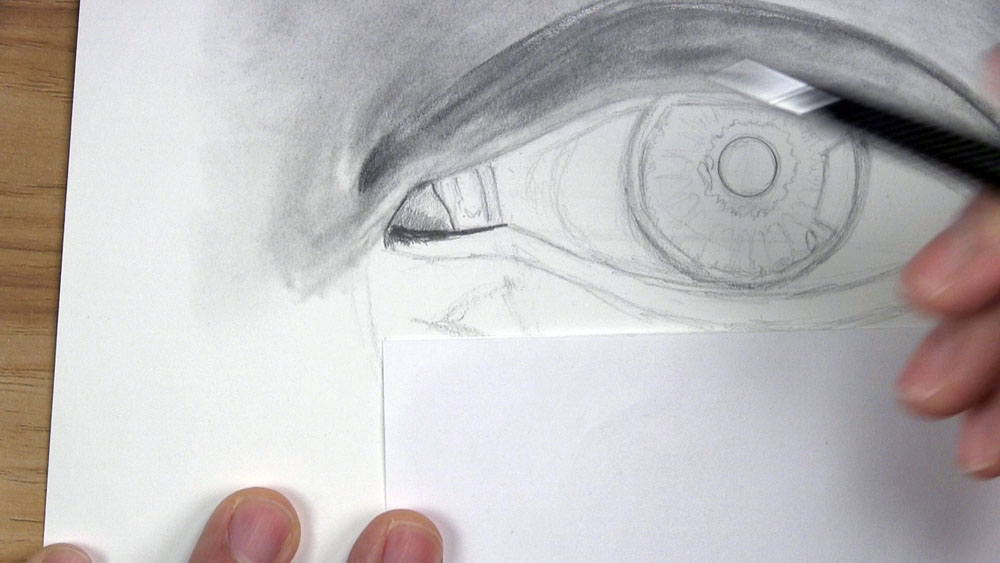
Then shade the next tissue, the plica semilunaris. Fun fact: this vestigial feature is sometimes referred to every bit the "third eyelid". Be certain to preserve a couple of areas for highlights.
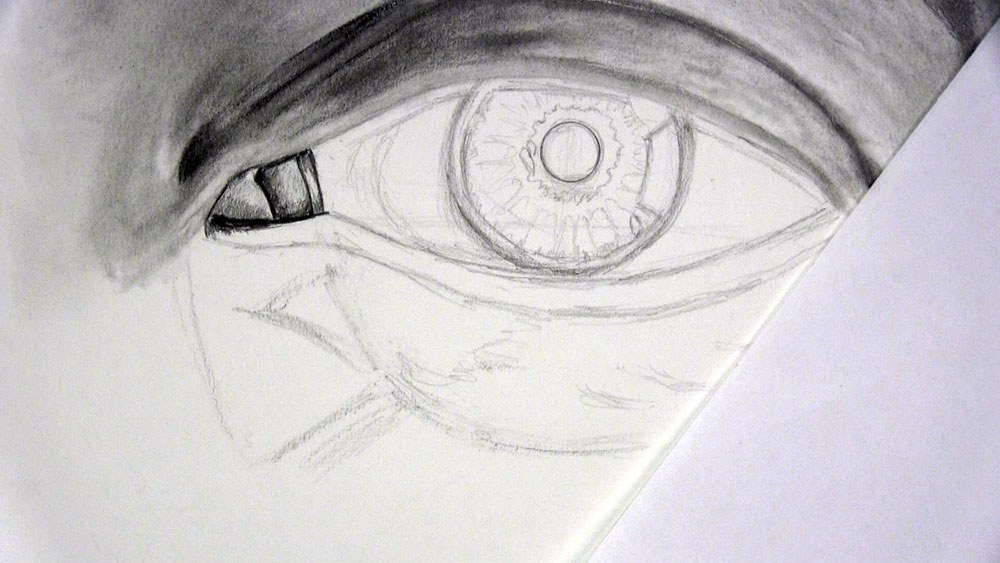
Smooth out the tones with a blending tool. Then lift highlights with a kneaded eraser. Alternatively, you lot tin utilize an electric eraser to create sharper highlights and a more than "wet" advent.
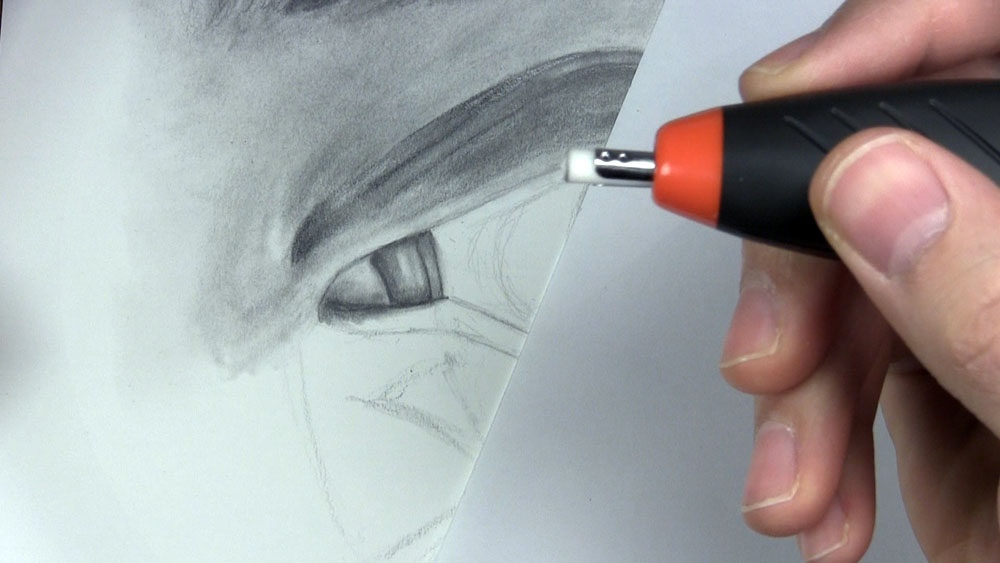
Build additional layers of shading, blending, and lifting highlights to complete the details at the corner of the eye.
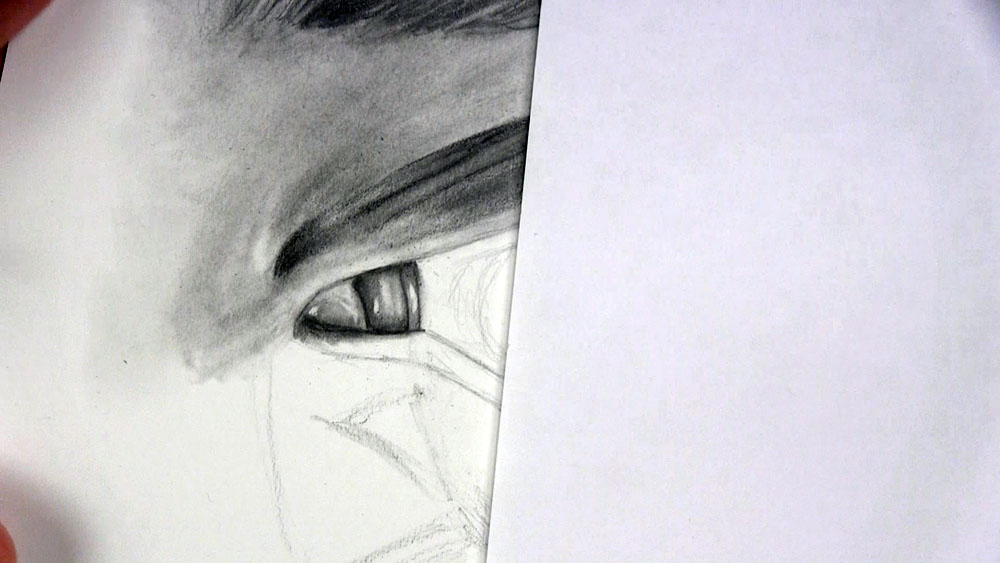
Shade the Pupil
Next, shade in the educatee. Use a circle template to make certain your pencil marks stay within the boundary of the pupil.
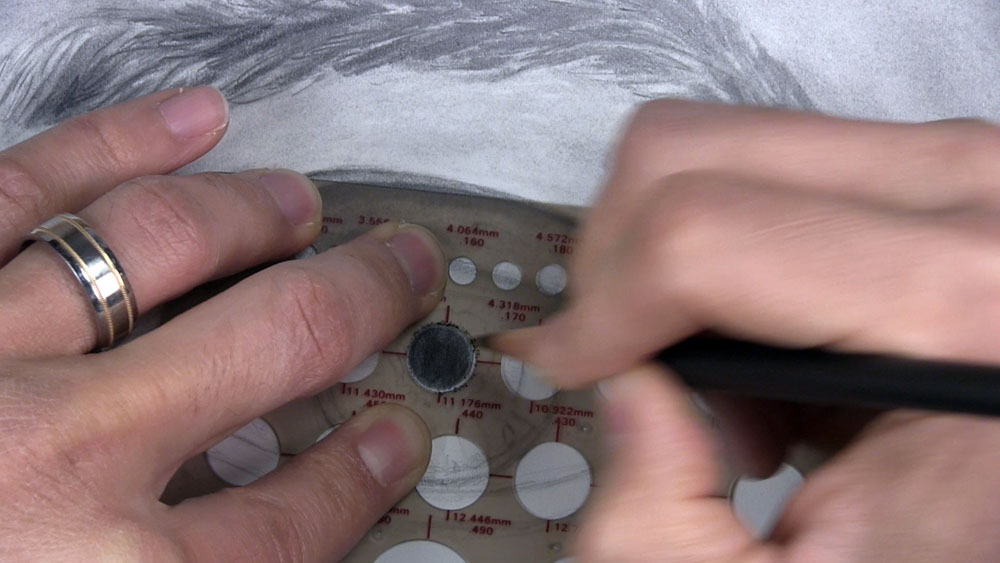
Become over the student with another layer of shading and a blacker pencil, like an 8B pencil. The pupil should be the darkest part of the eye. Afterwards, blend the pupil.
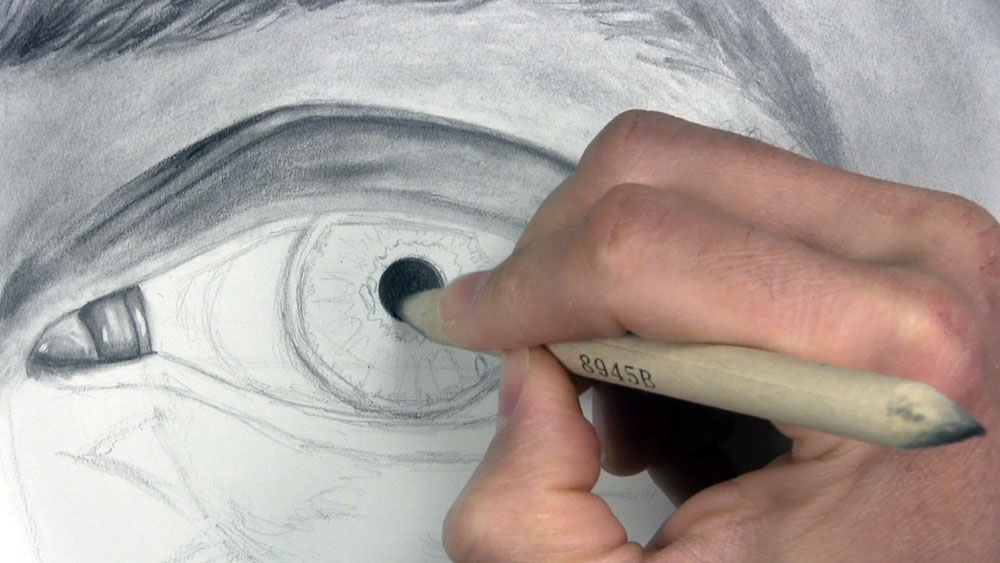
Shade the Iris
Now, let's run into how to describe a realistic iris. Shade the limbal band, which is the dark ring going around the outer edge of the iris. Make some short markings radiating from the outer edges toward the center of the pupil. Keep these markings close to the limbal ring, though. Too, identify some shading on the iris directly underneath the upper eyelid.
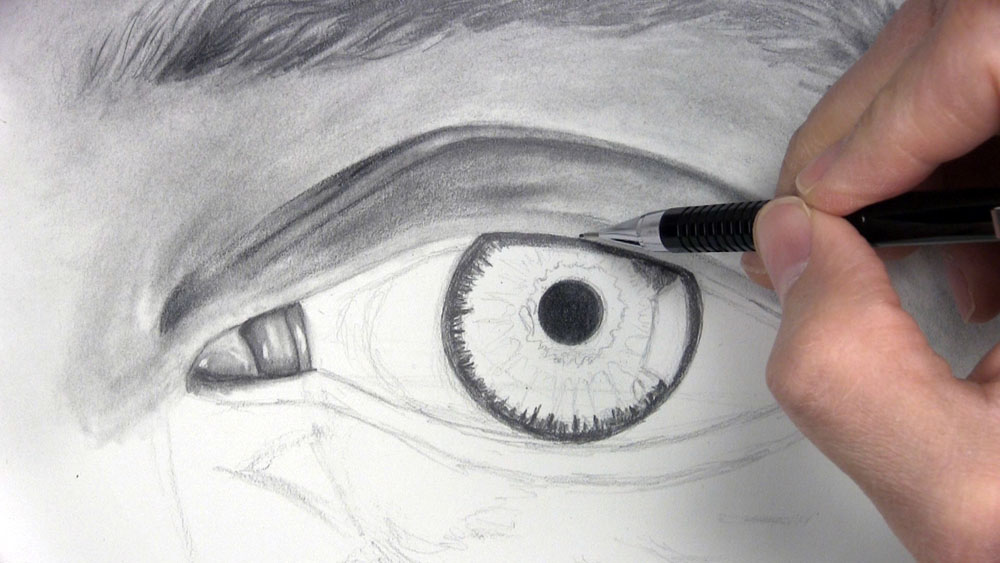
Make similar short markings around the pupil. Again, take intendance to brand these marks appear that they originate from the very eye of the educatee. Do not extend the marks beyond the squiggly line that surrounds the pupil. Circular the tiny space on the border of the pupil between each of these little marks. Do this by making trivial "u" or "north" shapes. Though subtle, this process replaces the perfect pupil edge created past the circumvolve template with a more natural and realistic border.
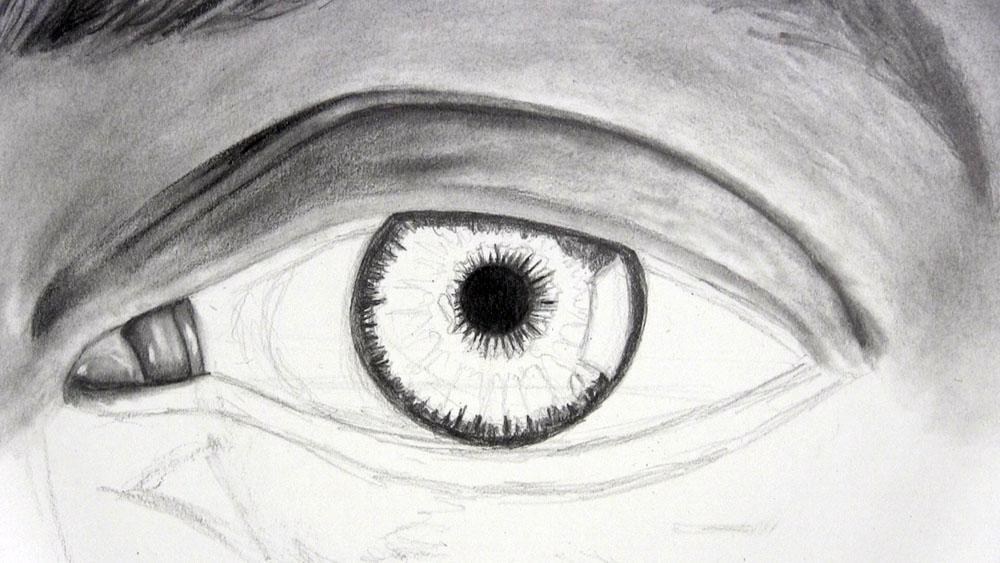
Next, shade all of the spaces on the iris that are betwixt the sunshine ray design pattern that we created during the line drawing. Make sure to leave the large highlight on the right side of the iris untouched.
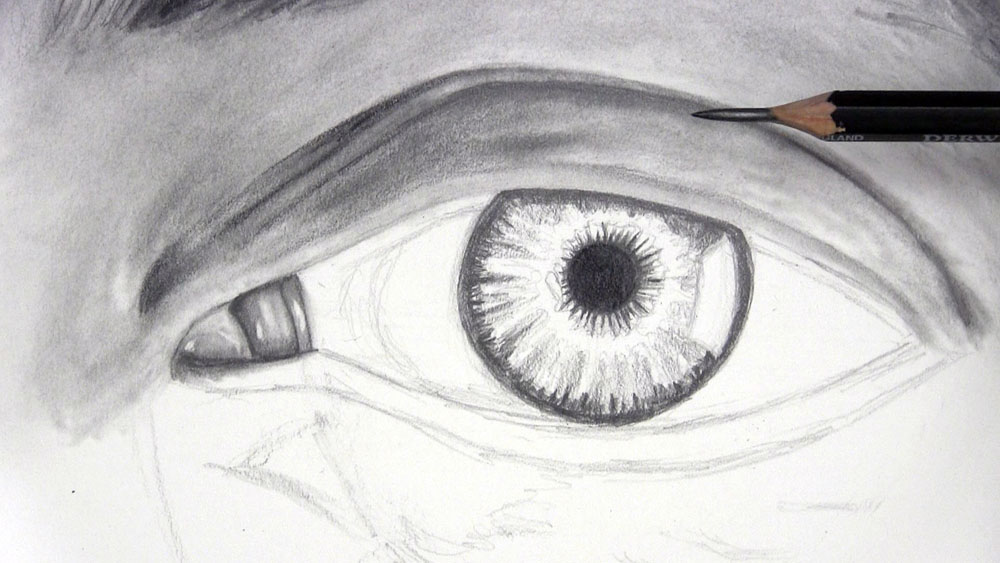
Put another layer of shading on the iris. Even so shade around the highlight and the band blueprint, but this time, emphasize some of the shading directly next to the blueprint.
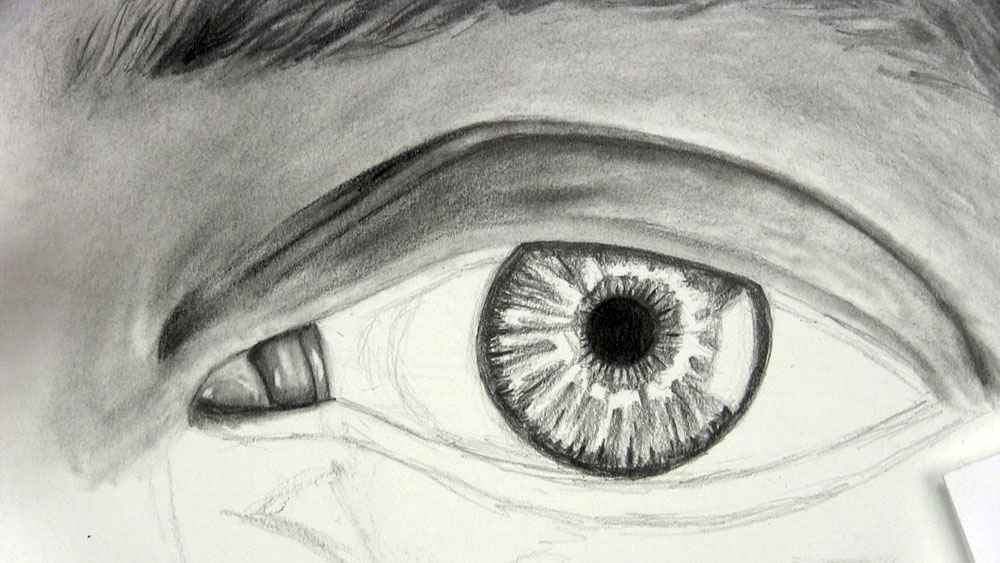
Use a tortillion to alloy the tones of the iris. Very lightly glaze over the white areas of the iris as well, with the exception of the highlight on the right.
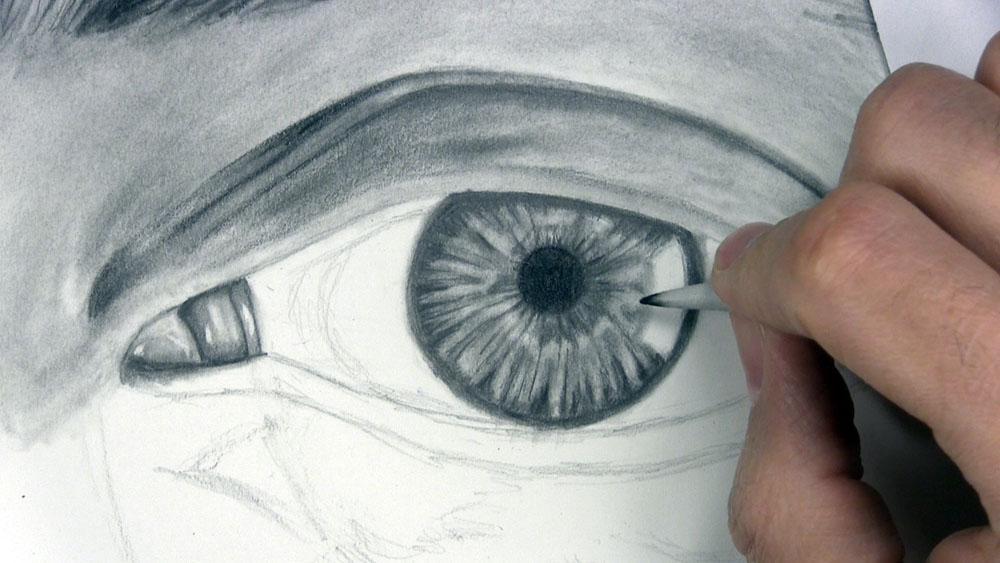
Add a terminal layer of details by drawing fine lines from the limbal band toward the center and vise versa. Depict lines in between the ray pattern to amend distinguish them. Utilize an electric eraser to lift some of the smaller highlights about the pupil and below the large highlight.
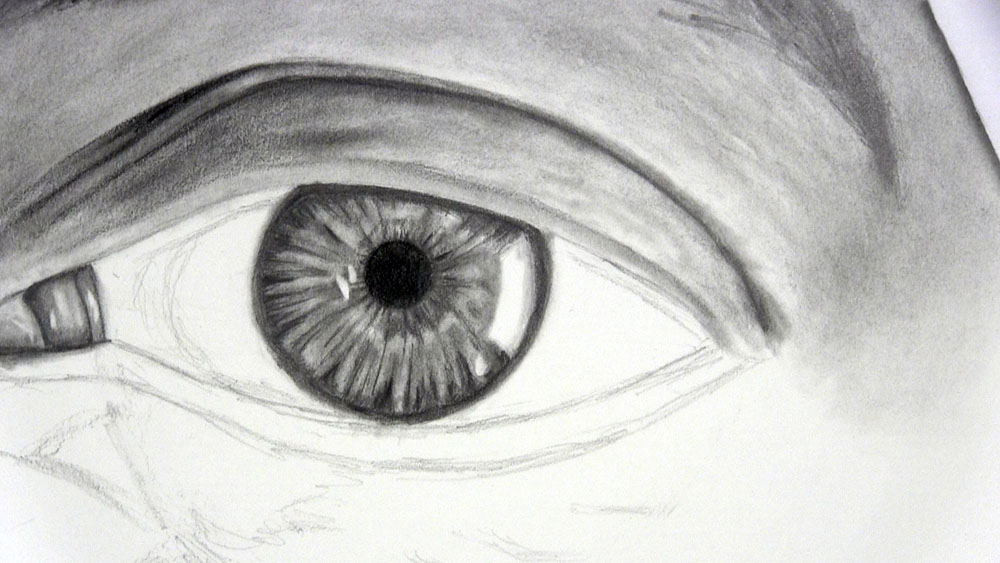
Shade the White of the Eye
Start shading the white of the center, too known as the sclera. Put some shading directly under the upper eyelid, which is leaving a cast shadow straight below it. Put some direct over the lower eyelid likewise, on the left side. And then, very lightly shade the white of the middle to the left of the iris. Your pencil strokes should follow the same curvature equally the iris and the spherical eyeball. Make your shading slightly heavier about the corner of the middle.
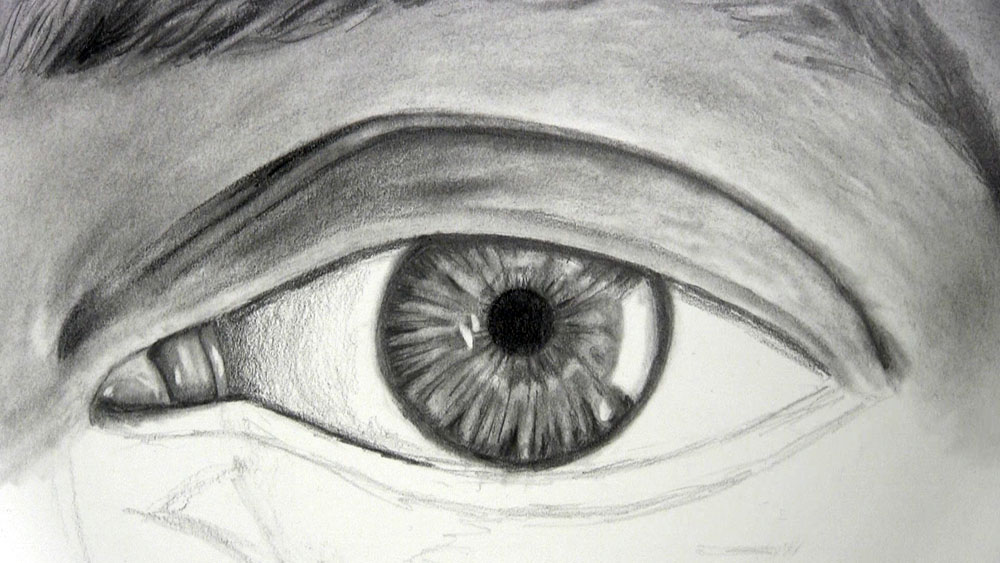
Alloy the tones of the sclera. Blend the cast shadow below the upper eyelid. Use some of the graphite accumulated on the blending tool to put some very light shading on the correct function of the sclera, at the corner and near the bottom. If necessary, apply a kneaded eraser to lift areas close to each side of the iris so they remain white. Draw very fine lines on each side of the heart for veins.
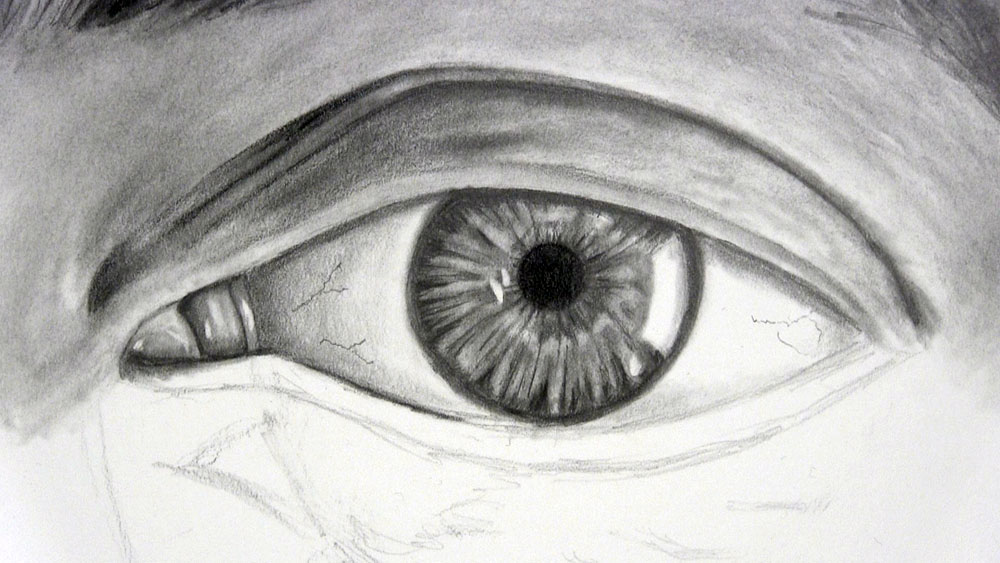
The veins on the sclera should be barely noticeable, so blend them. Lift them with a kneaded eraser if they appear too dark.
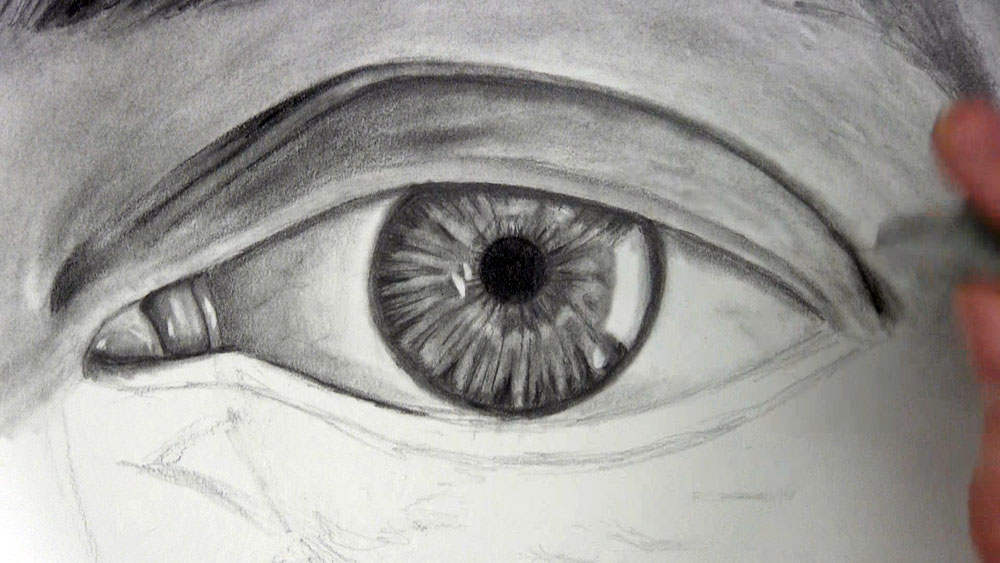
Utilise an electric eraser along the bottom of the centre to make some streaks of wet.
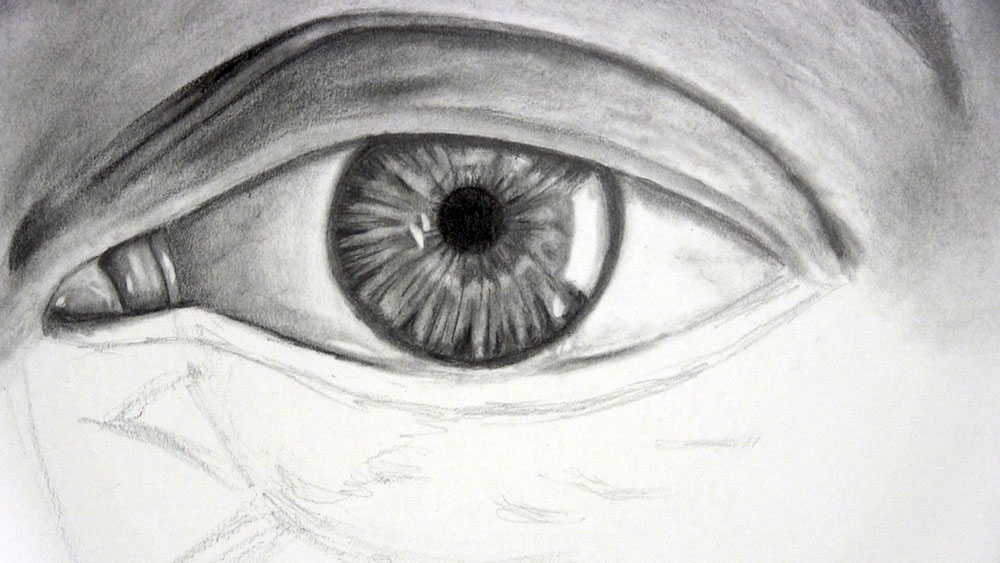
Shade the Lower Eyelid and the Area Beneath the Eye
Now, allow'due south focus on the area below the eye. Brainstorm by shading the upper border of the lower eyelid. Fifty-fifty here, just as everywhere else in the cartoon, you should be aware of variations between lighter and darker areas.
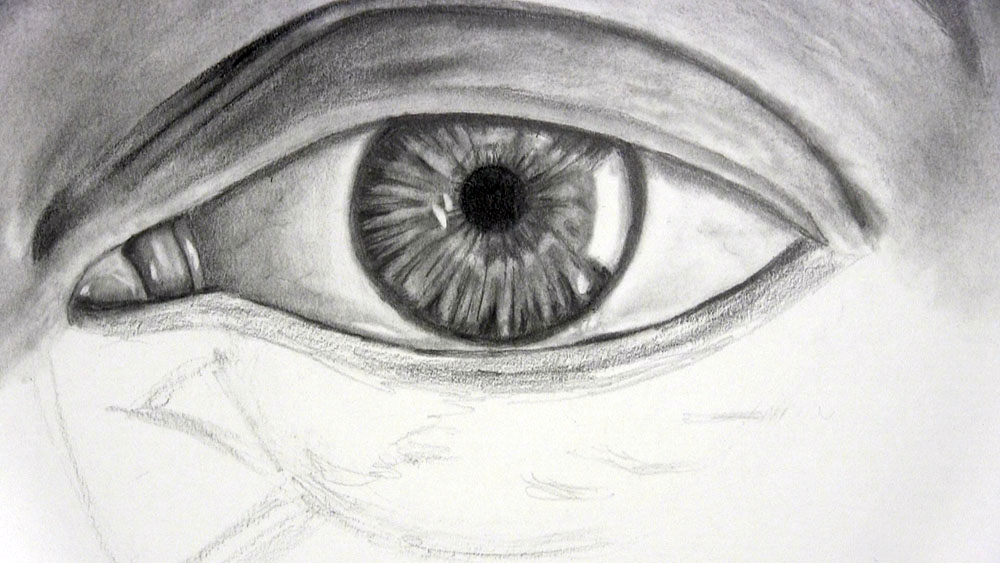
So, shade the entire area below the eye. Utilize the guidelines from the line drawing to recollect which areas should be darker, like under the inner corner, and which areas should exist lighter, like under the right side of the eye.
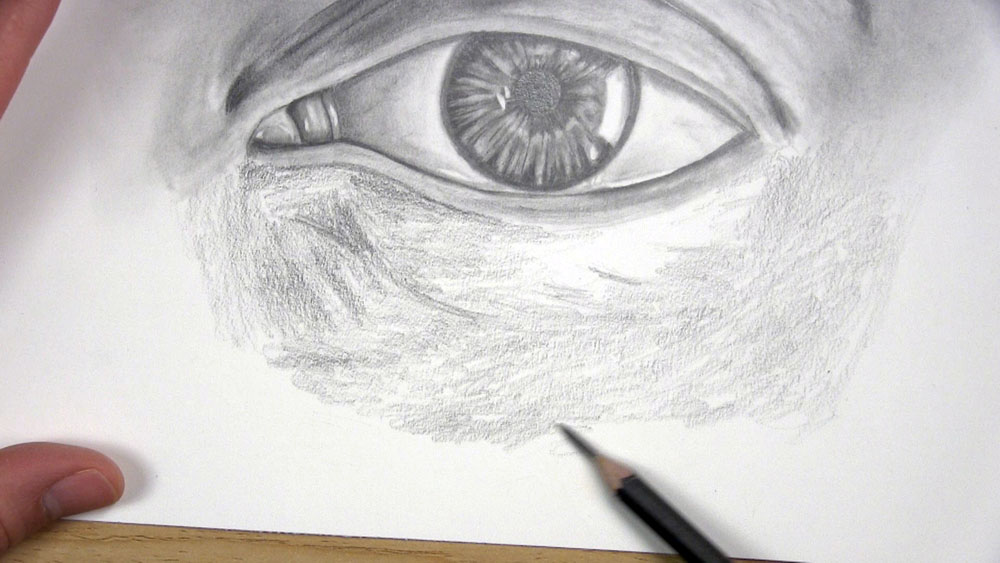
Use a blending stump to blend the pare tones. Blend around the highlighted areas.
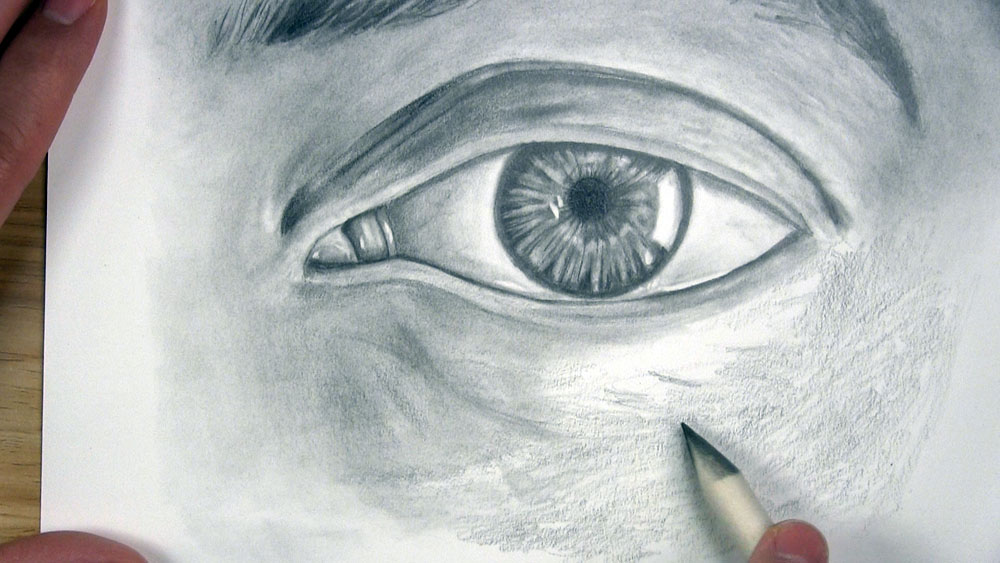
Place another layer of shading over the skin. Put extra shading under the inner corner. In the highlighted areas, employ a kneaded eraser and graphite from your pencil or blending tool to create textured areas of skin, just like nosotros did for above the centre.
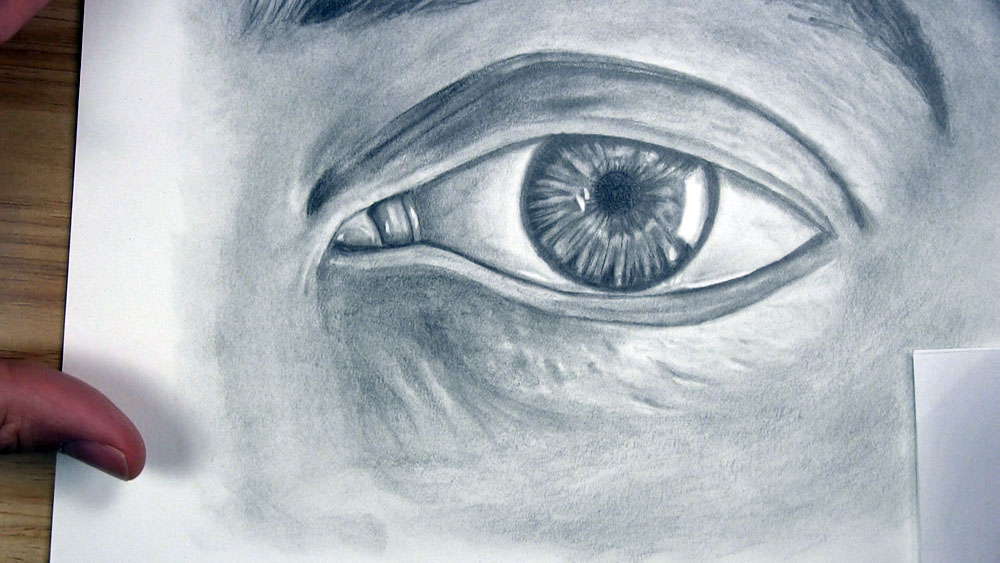
Draw the Eyelashes
Whenever I draw an centre, I always salvage the eyelashes for last. Hither is how you tin can depict realistic eyelashes. Begin drawing eyelashes coming down from the upper eyelid. I similar to starting time at the eyelid, or the root of the eyelash, and piece of work my way to the stop, tapering the eyelash with a gentle elevator of my pencil.
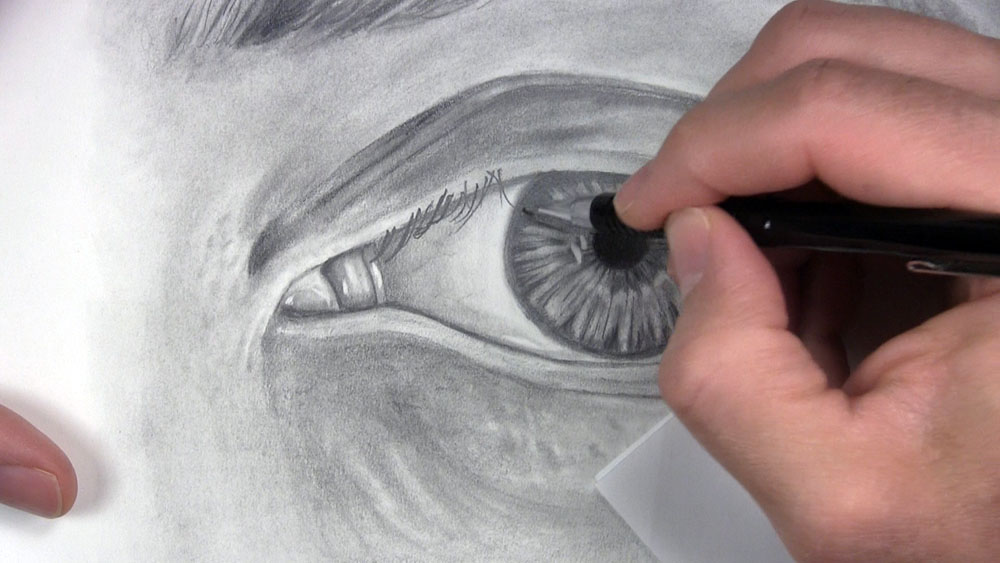
Use the reference photo to assistance you identify the eyelashes. Don't describe strong, evenly-spaced lines. Make your eyelashes await more than realistic past drawing some close together and some infinite farther apart. Draw some shorter and some a chip longer. Draw the longest eyelashes at the outer corner of the centre, with big swoops down and back upwards again.
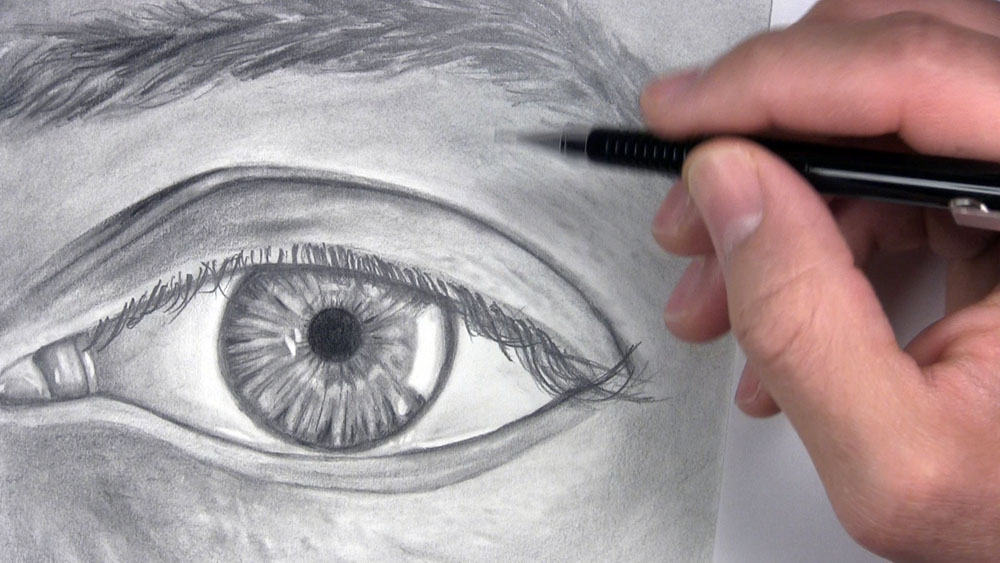
Gently blend over the eyelashes with a tortillion. This softens the eyelashes while too creating a little fleck of shadow from the eyelashes onto the eye behind it.
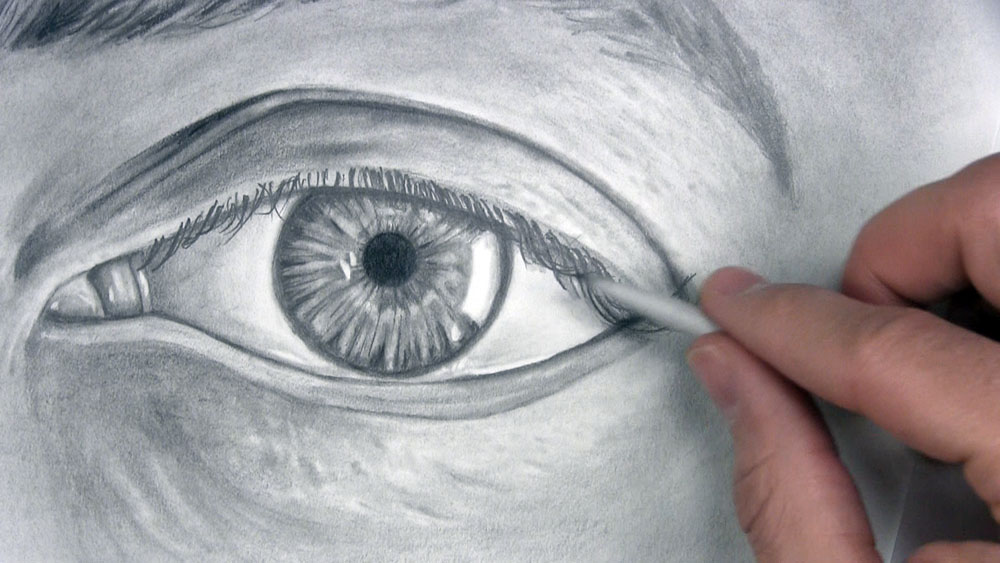
Use a precipitous pencil to draw the reflection of the eyelashes in the highlight of the iris. Start from the edge of the iris and draw inward with a slight bend and diagonal.
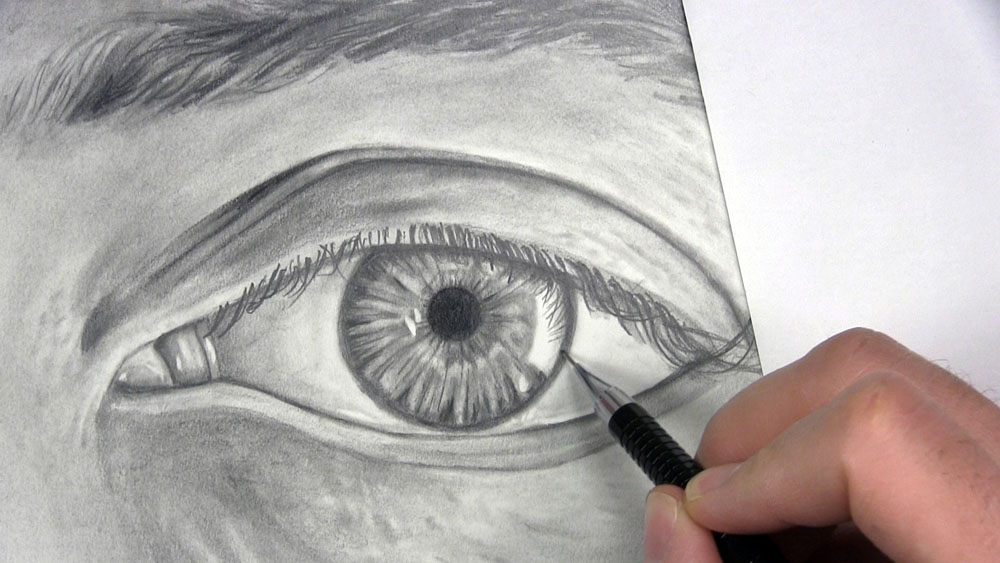
Side by side, draw the eyelashes on the lower eyelid. These eyelashes are non every bit plentiful equally the ones on the top eyelid. They are besides more scattered and accept a different curvature.
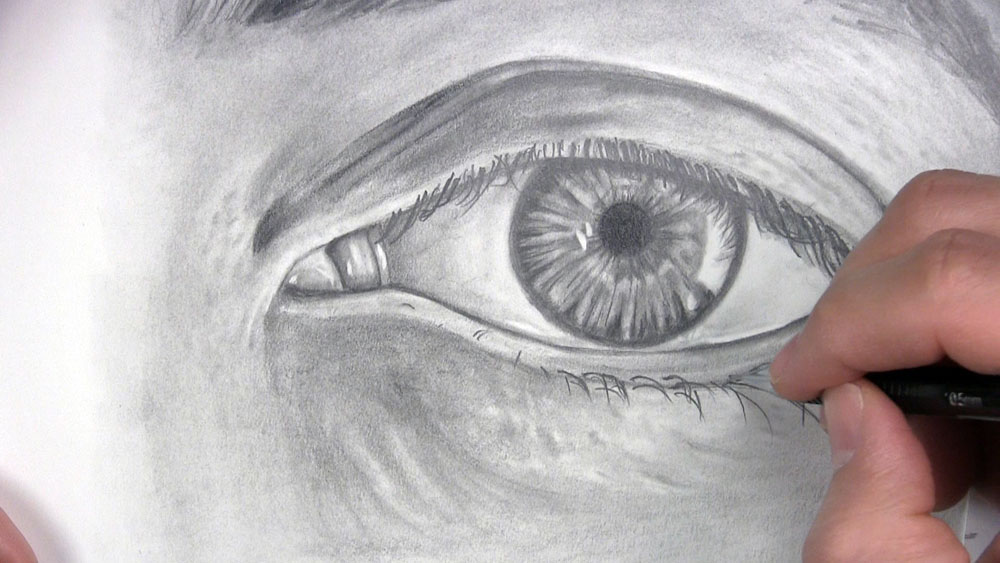
End cartoon the remaining eyelashes on the lesser and a few longer ones from the meridian that extend well beyond the outer edge of the center.
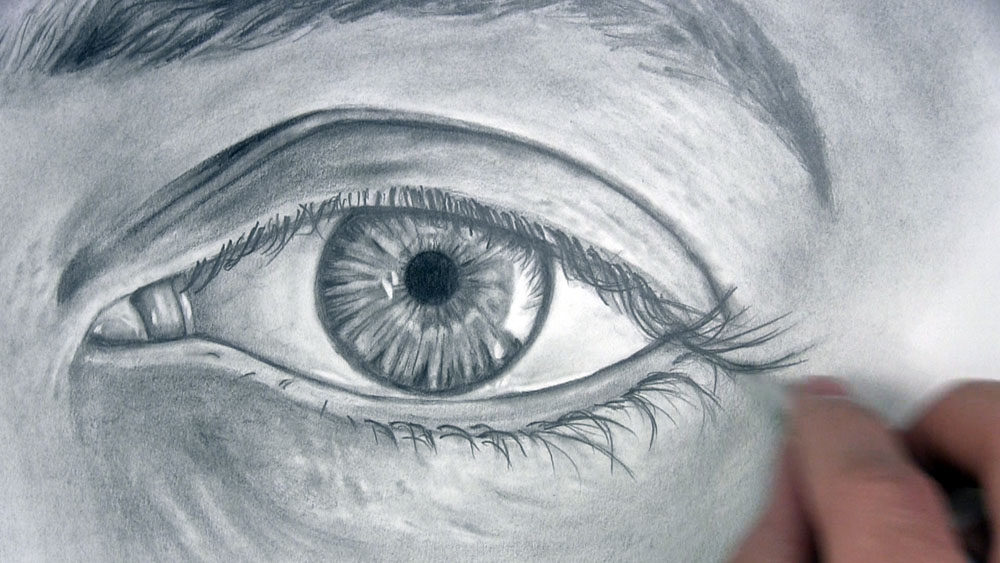
Take a final look at your eye drawing. Add together finishing touches by applying darker tones from a 6B pencil side by side to lighter ones to build contrast. Lift any highlights that need to be brighter. Touch upwards any areas and edges that demand to exist sharper or more composite.
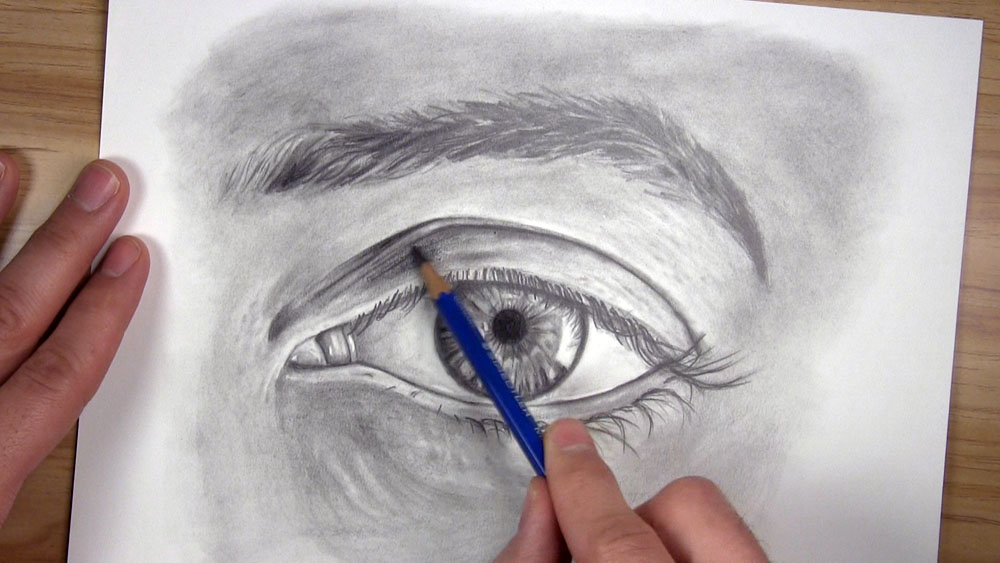
And that is how to draw a realistic center!
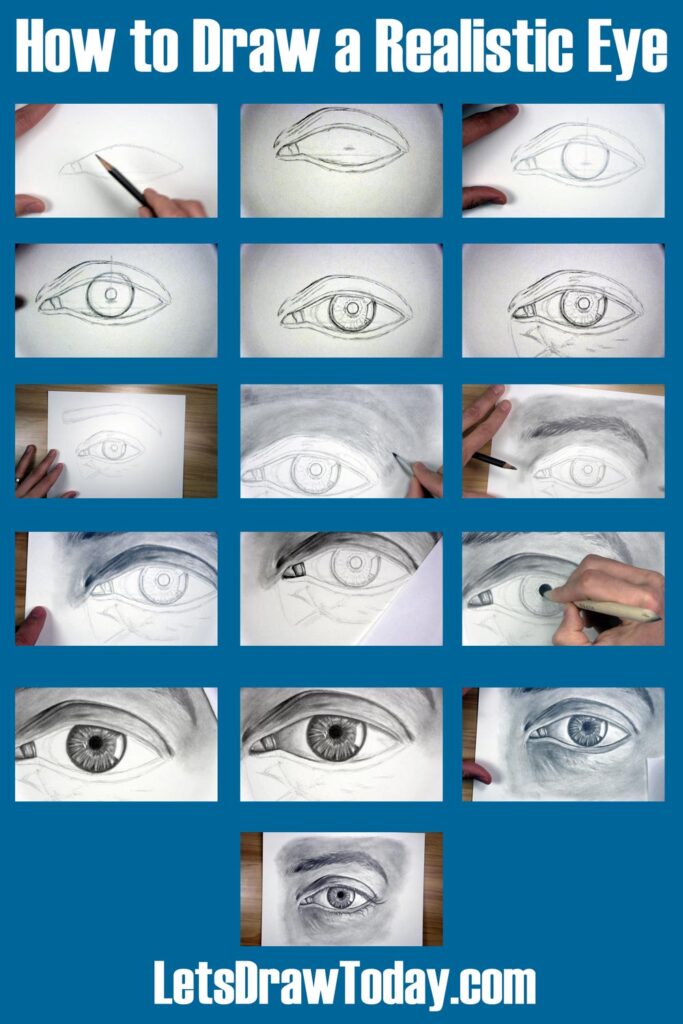
Tutorial Recap
For a quick visual recap of this tutorial, take a expect at the image beneath. It shows y'all a progression of the main steps for how to draw a realistic middle.
Tips to Remember the Next Fourth dimension You Draw a Realistic Eye
The next time yous are looking to draw a realistic centre, here are a few tips to continue in mind:
- Utilise a reference photograph so you tin can include all of the fiddling details about the heart that you might non recall about if you were drawing from groundwork knowledge lonely.
- While using a reference photograph, still call back to let yourself a footling bit of flexibility. If you lot are only drawing the middle of a person and not the unabridged face, at that place is less of a need to capture an exact likeness that resembles a person'south face. This means y'all can keep that eyebrow a piddling flake higher, you can include more or fewer eyelashes, or yous can vary the amount and placement of moles or wrinkles on the skin.
- Consider using both a color and a black-and-white version of your reference. You lot can use both photos together to give you data virtually lite and nighttime values every bit well as changes in color, such as the variations institute in the colorful design design of the iris.
- Attempt cartoon a multifariousness of eyes in a realistic way. Try drawing optics looking in unlike directions. Perhaps you tin can draw an eye from the side view. To create even more meaningful artwork, effort drawing eyes that convey dissimilar emotions, like surprise, sadness, or even anger.
Try the Extended Tutorial
Need more than help? In the extended video version of this tutorial, I give you more thorough explanations for every pace in the process as I draw this realistic eye from start to finish.
The unabridged video version of the tutorial is broken down into xvi shorter videos that focus on having you lot successfully complete ane important stage of the cartoon at a time. You will likewise have both colour and black-and-white reference photos available to assistance you.
You can get total admission to the extended version of this and all of my other tutorials by becoming a fellow member of the Let's Describe Today Gild.
If you have ever struggled with drawing an eye and making information technology look real, hopefully you have establish this eye-drawing tutorial helpful! More importantly, I promise you were following along and drawing an heart of your ain stride-by-step with me. If non, now is the perfect time to practice!


Source: https://letsdrawtoday.com/how-to-draw-a-realistic-eye/
Posted by: spencereaccon1998.blogspot.com
0 Response to "How To Draw An Eye Realistic"
Post a Comment